
Help build a country that works for mothers
We’ve spent generations teaching our girls to protect themselves. Here are 7 ways parents can make colleges do their part.
Every stage of motherhood is hard. It’s just a different kind of hard at each stage.
When our kids are babies, the hard is physical and mental all at once. Round-the-clock feedings, diaper changes at 3 a.m., and the constant low hum of worry about whether you’re doing any of it right.
Everyone warns you about those sleepless nights. Fewer people warn you about the ones that come later. Like when our kids leave home for college, but this time, what keeps you up is a phone that hasn’t buzzed and a mind running through everything that could go wrong somewhere you can’t see.
Every mom I know with a kid in college describes some version of that worry. Right now, for moms of daughters, it has a sharper edge. The headlines about sexual assault on campus keep coming: first Cornell, then, in a single week, a lawsuit alleging rape at a University of Chicago fraternity and federal charges in the death of a Fashion Institute of Technology student.
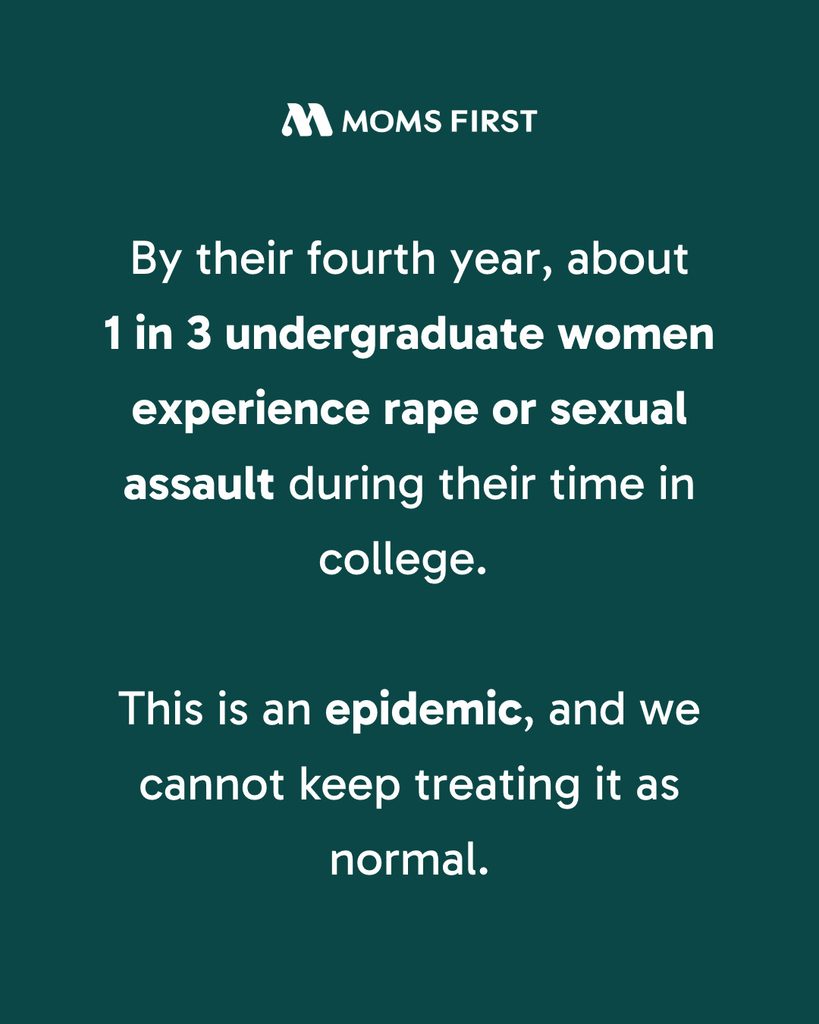
And these cases are not outliers. By their fourth year, about 1 in 3 undergraduate women experience rape or sexual assault during their time in college. This is an epidemic, and we cannot keep treating it as normal.
A couple of weeks ago, I wrote about this moment as a boy mom and just this afternoon I joined NBC News Daily to discuss it. As a mom of two boys, I want to raise sons who are brave enough to speak up when they see something wrong, even when it costs them. After that piece, my inbox filled up with messages from moms of daughters. So many said a version of the same thing: Imagine being the mom of a college-aged daughter right now. How do we keep them safe?
We’ve Been Preparing the Wrong People
As women, we’ve all been handed the same checklist for staying safe. Our mothers gave it to us, and many of us have caught ourselves rehearsing it for the young women we know. Walk in a group. Don’t wear headphones at night. Never leave your drink unattended. Hold your keys between your fingers in case you need to use them as a weapon. Step off the elevator if the man inside makes you uneasy.
Read that list again. Every item on it assumes our daughters are prey, and that the best we can do is help them avoid being hunted.
Some of that advice may help in a given moment. But for generations, it has been the entire strategy. We have poured energy into training girls to move through the world defensively and spent almost none going after the offenders, or the institutions that let them keep offending.
So I want to offer a different kind of college prep. Instead of another list of rules for our daughters, here is a guide for us as parents. Whether your daughter is touring colleges this fall or already living on campus, every one of these seven things is something you can do now.
1: Know the Red Zone
Here is what makes me angry: campus sexual assault is predictable. Researchers know when and where it happens most, and so do the schools.
The first year is the most dangerous. Advocates call the early months of college the “red zone,” and in a major campus survey, 16 percent of undergraduate women reported nonconsensual sexual contact involving force or incapacitation in their freshman year alone.
Game days are dangerous, too. At schools with Division I football programs, reports of rape among women ages 17 to 24 jump 28 percent on game days.
When the risk is this predictable, there is no excuse for a school that doesn’t take substantive measures to prevent it.
2: Read the Crime Report, Then Read Between the Lines
Every college that takes federal student aid has to publish an Annual Security Report each fall with campus crime statistics, including sexual assault. You can compare schools side by side using the Department of Education’s campus safety data tool.
Be careful how you read it though. A low number can mean a safer campus, or a campus where students don’t trust the system enough to report.
That’s why the more revealing question is whether a school surveys its own students and publishes the results. At Cornell, a 2025 university survey found that 35 percent of undergraduate women reported experiencing non-consensual sexual conduct.
If a school won’t share its number, that tells you something, too.
3: Take a Hard Look at Fraternities
Cornell and the University of Chicago, the two campuses at the center of this fall’s headlines, have something in common: the alleged assaults happened at fraternity houses. That pattern is not new.
The University of Chicago lawsuit shows how that culture is allowed to continue. According to the complaint, the fraternity’s national organization knew about prior sexual assault reports at the chapter and still did not suspend it or restrict its parties.
So do your homework. Under a federal law passed in 2024, colleges now have to post a Campus Hazing Transparency Report listing student organizations found responsible for hazing, updated at least twice a year. Search the school’s website for “hazing transparency report.”
Then notice what’s missing. The law covers hazing, not sexual misconduct. Ask the school whether it will publish organization-level findings for sexual misconduct, too. One parent asking is an inconvenience. Thousands of parents asking is a policy change.
And when you’re weighing schools, look at how much of campus social life runs through fraternity houses. If the answer is nearly all of it, that’s a red flag.
4: Ask the Questions They Leave Off the Campus Tour
During an open house, or in an email to the school’s Title IX office, ask:
- How many sexual misconduct complaints did you receive last year, and how many ended in a finding of responsibility?
- What sanctions did those students receive?
- How long does an investigation take, start to finish?
- If a student is expelled, or withdraws while under investigation, is it noted on their transcript?
The sanctions question matters more than most parents realize. A CNN review of Cornell’s records found students were held responsible in 16 of 51 formal sexual assault complaints over four years, and only two were expelled.
5: Remember Who Pays the Bills
Parents write the tuition checks, and alumni write the donation checks. Universities listen to both. After the Cornell allegations became public, an alumni petition pledging to withhold donations until the university shows accountability drew tens of thousands of signatures.
You don’t need a petition to use that power. If you give to your alma mater, write to the president and the board of trustees and tell them your next gift depends on transparent reporting and real consequences. If you’re a parent, send your questions to the president’s office, not just admissions.
6: Find Out What Your State Requires
Some gaps can only be closed by law. New York and Virginia require colleges to note on a transcript when a student is suspended or expelled for sexual assault, so that student can’t simply start over at a new school with a clean record. Most states have no such rule. Ask your state lawmakers whether yours does.\
7: Back the People Already Doing This Work
The Cornell story reached the whole country because student journalists at The Cornell Daily Sun refused to let it go, and the University of Chicago lawsuit was first reported by that campus’s student paper, The Chicago Maroon.
Subscribe to the student paper at your kid’s school, or donate to it. Ask your daughter, and your son, which student groups are pushing for change, and how you can help them.
We can’t follow our daughters to every party or walk them home every night, but we can make sure the schools they call home know we’re watching. Pick one question from this list and send it to your daughter’s college this week, because every answer they have to give is a step toward a campus that protects her.

Bring No Country for Mothers to Your Campus
Some of the most important conversations of my life happened on a college campus. That’s why I want No Country for Mothers on campuses across the country.
If you’re a proud alum, a student, a professor, or part of a college community in any way, you can make it happen. Host a screening for your alumni chapter, your women’s network, your graduate student group, or a department that should be having this conversation.
Our new Campus Community Hosting Toolkit has everything you need to get started. Take a look, then schedule your screening today.
No Country for Mothers: Screenings Happening Near You
Check for a local screening in your city or join a virtual watch party.
- Virtual Watch Party (NY), Oct 24, 2 PM — RSVP
- South Burlington, VT, Oct 24, 2 PM at South Burlington Public Library — RSVP
- Virtual Watch Party (UT), Oct 24, 6 PM at Indie Square — RSVP
- Arlington, VA, Oct 25, 2:30 PM at Central Library — RSVP
- Rapid City, SD, Oct 25, 4:30 PM at Loam Yoga — RSVP
- Schenectady, NY, Oct 26, 10:45 AM at Mont Pleasant Branch Library — RSVP
- Virtual Watch Party (MN), Oct 26, 12:15 PM — RSVP
- Gettysburg, PA, Oct 27, 7 PM at Breidenbaugh Hall — RSVP
- Montpelier, VT, Oct 28, 6 PM at Greenway Campus — RSVP
- Virginia Beach, VA, Oct 28, 6 PM at Lovegodesss Women’s Studio — RSVP
- San Diego, CA, Oct 28, 6 PM at San Diego Made Factory — RSVP
- Atlanta, GA, Oct 29, 6 PM at Woodruff Arts Center — RSVP
- Mount Vernon, IA, Oct 29, 6:30 PM at United Methodist Church — RSVP
Want to host your own? Head to our Host Hub for all the info you need to set up your event.
Our daughters should keep trusting their instincts. But the responsibility for a safe campus belongs to the people who run it. It’s time parents aimed our questions and our checkbooks where that responsibility actually lives.
For our daughters,
