
Why the Lindsay Clancy case lands so differently depending on who’s watching
Yesterday, the jury in Massachusetts began deliberations and will soon decide where the line falls between illness and blame in the case of Lindsay Clancy, the mother on trial for killing her three children after a psychotic break she and her doctors say was postpartum psychosis.
I’ve watched two very different reactions to this case play out. Women keep telling me some version of the same thing: they see themselves in her. Not because they’ve experienced anything as severe as psychosis, but because they know exactly what it feels like to be failed by the system that’s supposed to catch you once you become a mother. The isolation. The thirty-minute check-up. The sense that once the baby arrives, you’re on your own and whatever happens next is on you.
A lot of men have reacted differently. They can’t understand why any of this case feels complicated.
I don’t think that’s about men being incapable of empathy. I think it’s about the fact that, when it comes to raising kids, many men have simply never lived through what the women around them have.
A woman becomes a mother inside a system that fades her into the background the moment the baby is born. A man, more often than not, becomes a father inside that same system and gets celebrated for simply being there. Two people can walk through the same delivery room and walk out having lived through two very different experiences inside the same system. One of them recognizes the collapse because she’s felt it. The other has never had a reason to look for it.
That’s not universal. Plenty of men know exactly what it’s like to be failed as a parent by a system that wasn’t built for them either. But for a lot of mothers watching this case, the recognition is instant, and for a lot of fathers, it isn’t, and that gap is showing up in how differently we’re all reacting to it, including in a courtroom right now.
If any part of this sounds familiar to you, the isolation, the sense that struggling makes you a bad mother, you’re not imagining it, and you’re not alone in it.
A few weeks ago, I wrote about all of this on my Substack. If you missed it then, or you’ve been watching this case unfold since, it’s worth reading now so I’m sharing it in full here.
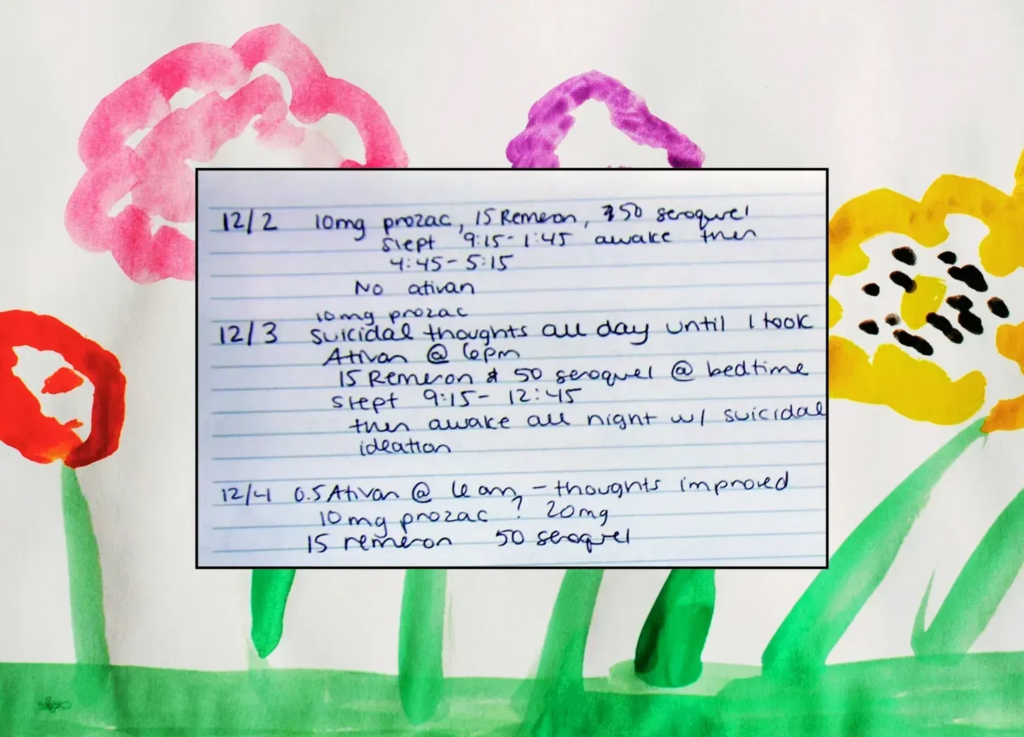
Everyone Failed Lindsay Clancy
It could’ve happened to you, too.
”I am completely overwhelmed.”
“I’m drowning every day.”
“I feel guilty.”
“I’m really worried about going back to work.”
If you are a mother, you could have written any of these confessions.
Each of these was written by Lindsay Clancy.
I’ve been following her story for weeks, trying to figure out how to write about it. I still don’t have that figured out. So I’m just going to write anyway.
Lindsay Clancy was a labor and delivery nurse, helping to bring babies into the world. She was a wife, and a mother of three children under six, and by every account from the people who loved her, she was devoted to them. Her nanny said she was a wonderful mother. Her husband said the same. He testified that even in the depths of her psychosis, she was the one who still managed to plan and buy the supplies for their daughter’s birthday party. His wife, drowning in a mental health crisis so severe it eventually cost her children their lives, was weeks before, still doing the invisible labor of motherhood, still trying hard to be a “good mom.”
She was set-up to fail.
We spend nine months worshipping women when they are pregnant. We throw showers. We ask for the due date and run a countdown clock. And then the baby arrives, and the mother, the body and soul who nourished and protected this child for almost a year, disappears from the frame. Before she leaves the hospital, she has a 30% chance of being screened for postpartum depression, and most likely using a 10-question survey created in 1987. A single piece of paper that’s shorter than the paperwork to register the new baby for a Social Security Number will confirm if she’s mentally fit to keep both herself and her new baby alive at home. Nobody asks mom how she’s sleeping. Nobody asks to come over to hold her. Nobody follows up in any meaningful way between birth and her six week check-up that lasts 30 minutes. And after that visit, well, good luck, babe! She’s on her own.

American motherhood is not broken by accident. It is functioning exactly as designed. We do not mandate paid maternity leave. We let women die during childbirth. We do not offer affordable childcare. We do not give mothers the job protection or flexibility they need. We ask women to do the most physically and psychologically demanding work of their lives with none of the infrastructure that every other wealthy nation considers a non-negotiable. And then, when a mother cracks under a weight no person should be asked to carry alone, we call her the worst thing you can call her: a bad mother.
The fear of being a bad mother in a country that disrespects them all the same is killing us. It was the fear of being a bad mother that drove Lindsay to leave in-patient care and jump head first into buying balloons for her daughter’s birthday. It was the fear of being a bad mother that kept her up late at night, wondering how she could both show up for her children and pay the bills.
Lindsay asked for help. She tried multiple times, multiple ways, with multiple providers to get well. And still, the system that was supposed to catch her did not catch her. Everybody, and I mean, everybody in Lindsay’s life failed her and her children.
Postpartum psychosis is a psychiatric emergency, one of the most dangerous conditions in all of maternal medicine, and we do not treat it like one. We love to call it “rare” but it affects up to 7,000 American women a year, and about half of those women will have zero pre-existing psychiatric history. We have the highest maternal mortality rate in the industrialized world, and that statistic does not even capture what happens to the women who survive childbirth only to be left alone with a mind that has turned against them.
And then there’s us. Women are our second-worst enemy in this nightmare. I have read the comment sections under every story about Lindsay in my feed, and I wish I could tell you it was mostly men being cruel. They are there, commenting without lived experience. But women who should know better are drowning them out.
There’s a reason so many mothers are hooked on this case, following it religiously like a serial true crime podcast. E.J. Dickson has a theory about this phenomenon in her excellent book One Bad Mother. She writes about our cultural appetite for stories of mothers who harm their children, and why women in particular become engrossed. Some follow along out of sheer genuine horror and curiosity. But most, she argues, do it for relief. Every time we consume a story like Lindsay’s and walk away thinking “I would never,” we get to put ourselves on the right side of an invisible line. We get to feel, for a moment, like good mothers, which is the one label this culture has convinced us we might lose at any time. Comparing ourselves to the worst version of a “bad mother” is easier than reckoning with a system that could break any of us.
“I had postpartum depression too, and I didn’t do what she did.”
“I don’t believe her.”
“I would never.”
I see these comments by the hundreds. We want to believe we would never. But every time a woman writes a sentence like that, she is doing the system’s work for it, for free. She is helping erase the fact that postpartum psychosis is not postpartum depression, that it is a distinct and rare and catastrophic break from reality, and that she merely beat a game of chance. You, yes, you, could have done what Lindsay did.
We cannot demand our health be taken seriously, our mental health be taken seriously, our motherhood be taken seriously, while we are first in line to tell each other our suffering is not real. This is the culture wars at play, whether we want to admit it or not, and right now we are losing it from the inside.
Lindsay Clancy needed a country that took her seriously before the worst day of her life. She did not get one. Neither did her children. The least we owe them now is to stop giving reasons why it couldn’t happen to us, and start asking why it was ever allowed to happen to her, and what we’re going to do to stop it for other mothers.

Reading about a story like this can bring up a lot, whether it’s grief, recognition of your own struggle, or both. Here’s where to turn.
- If you’re struggling. If you or someone you love is experiencing postpartum depression or psychosis, please don’t wait to get help. Call or text 1-833-TLC-MAMA, the National Maternal Mental Health Hotline, free and confidential, 24/7. If you’re in crisis, call or text 988. Postpartum psychosis is a medical emergency, not a personal failure.
- Take the ‘Support Not Shame’ Pledge. Every mother deserves to struggle without being told it’s her fault. Sign the pledge and help build a culture where asking for help isn’t treated as a confession.
- Share your postpartum experience. As part of the American Motherhood Tour, we’re collecting stories from moms around the country.

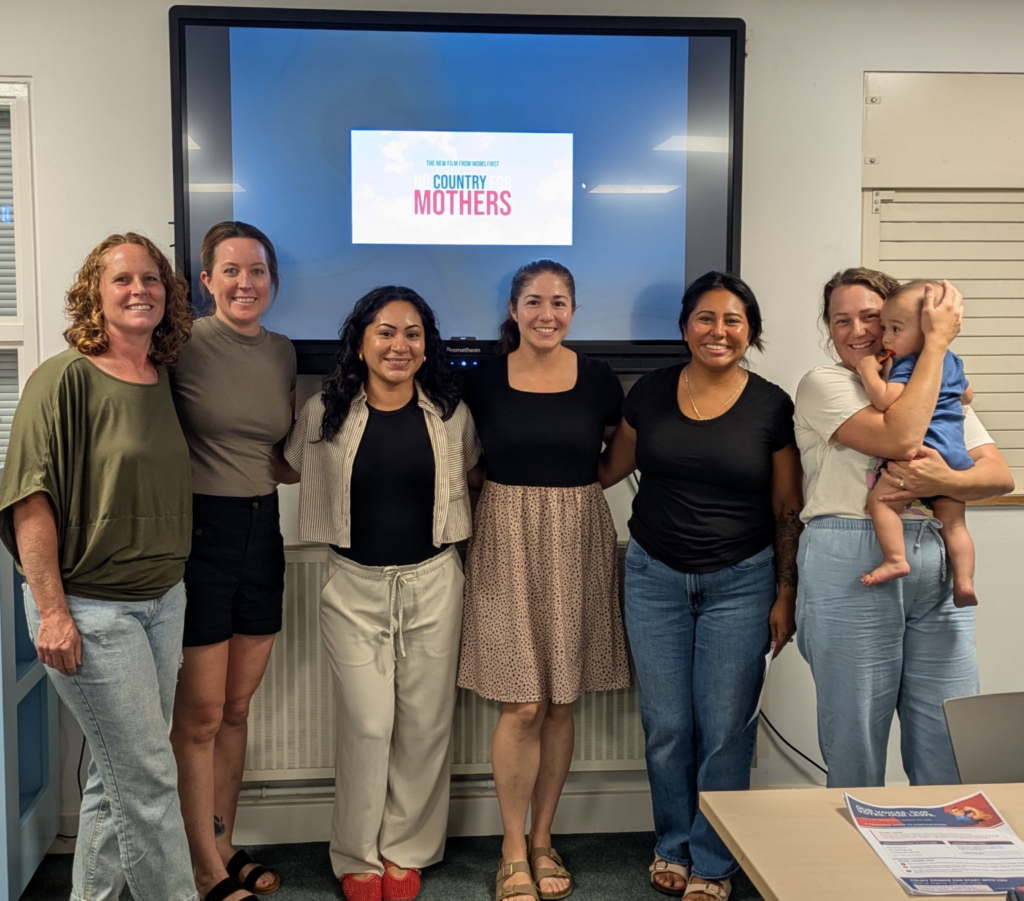
We’re grateful to Cynthia Meadows for bringing No Country for Mothers to the UK by hosting a screening for military spouses who are on base there.
Interested in hosting an international screening? Email us at hello@momsfirst.us
No Country for Mothers: Screenings Happening Near You
Summer’s winding down, but watch parties aren’t. No Country for Mothers screenings are happening well into fall and winter. Pick a date, invite your crew, and host a screening of your own. Or if hosting isn’t your thing right now, grab a mom friend and attend a screening near you or virtual watch party.
- Township, NJ, Aug 31, 6-9 PM at Haddon Township Library — RSVP
- Washington, DC, Sept 1, 5:15-7:30 PM at The Avalon Theatre — RSVP
- Prospect Heights, IL, Sept 1, 6:30-8:30 PM at Prospect Heights Public Library District— RSVP
- Virtual Screening (New York), Sept 1, 8:30-10:30 PM — RSVP
- Coral Gables, FL, Sept 2, 6-7:30 PM at Coral Gables Congregational United Church of Christ — RSVP
- Virtual Screening (New York), Sept 3, 9:30-10:30 AM — RSVP
- Honolulu, HI, Sept 3, 4-7 PM at Hawaiʻi School for Girls at La Pietra — RSVP
- Jeffersonville, IN, Sept 5, 5-8 PM at Maple Leaf Academy — RSVP
- Charlotte, NC, Sept 6, 1-3:30 PM at The Independent Picture House — RSVP
- West Hartford, CT, Sept 8, 6-8 PM at Noah Webster Library — RSVP
- Spring, TX, Sept 8, 5:45-7:45 PM at George H.W. Bush Community Center — RSVP
- Bothell, WA, Sept 8, 6-7:30 PM at Bothell Library — RSVP
- Lopez Island, WA, Sept 8, 6-8 PM at Lopez Island Library — RSVP
- Virtual Screening (New York), Sept 9, 8-10 PM — RSVP
- Barnwell, SC, Sept 10, 5:30-7:30 PM at Barnwell Public Library — RSVP
- Philadelphia, PA, Sept 10, 6:30-8:30 PM — RSVP
- Cornish, ME, Sept 10, 6:30-8:30 PM at Cornish United Church of Christ — RSVP
- Virtual Screening (New York), Sept 11, 12:30-1:30 PM — RSVP
- Breckinridge County, KY, Sept 11, 5:30-8:30 PM — RSVP
- San Diego, CA, Sept 11, 6-8 PM at Stone Brewing World Bistro & Gardens – Liberty Station — RSVP
- Franklin Farm, VA, Sept 12, 10-12 PM at Epiphany Episcopal Church — RSVP
- Virtual Screening (New York), Sept 12, 2-4 PM — RSVP
- San Jose, CA, Sept 12, 1:30-3:30 PM at Rose Garden Branch Library — RSVP
Want to host your own? Watch parties can be in your backyard, living room, a local library, your church, movie theater, or wherever moms gather. Help bring moms together in community to talk, watch, and support one another.
Head to our Host Hub for all the info you need to set up your event.

Thinking About Hosting a Watch Party? Attend a Virtual Office Hour.
Whether you’re still deciding or already signed up to host a No Country for Mothers screening, join us for a casual virtual office hour on Thursday, September 10 from 1:30-2 PM ET. No prep needed, just show up. Come get your questions answered, pick up a few hosting tips from our team, and leave feeling ready to bring your community together.
We’re Taking Our Own Advice
If you’re a parent, you know this stretch of late summer: the kids aren’t quite back in school yet, camp is over, PTO is running thin, and the whole household is held together with tape. That’s why our office is closed from August 31 through September 7. Every year we hit pause at the tail end of summer so our team can rest before the school-year sprint begins. We spend our days telling employers that supporting parents isn’t a perk, it’s the job. We’d be pretty bad at our jobs if we didn’t practice that ourselves.
We’ll be back in your inbox on the other side. In the meantime, if you need something to read, we’ve got more than 70 issues of The First Word waiting for you in the archive.
Whatever verdict comes out of that courtroom, it won’t undo what’s already true: we built a system that leaves mothers alone at the exact moment they need us most, and then we act surprised when it breaks someone. Lindsay Clancy’s children deserved a mother who was caught before she fell. Every mother reading this deserves the same. That’s the work. Not judging her from a distance, but closing the distance for the next one.
Thank you for being here, for reading past the headlines, and for building something better with us.
In solidarity,
