Help build a country that works for mothers
It’s budget season, and employee surveys are open. Here are six ways to build your business case.
Ask any working mom what she wants from her job, and I promise the answer isn’t a ping-pong table in the break room. She wants to leave work on time without an apology so she can make pickup, and to stay home with a sick kid without worrying it’ll cost her the next promotion. She wants to be seen as a great employee and a great mom, because she’s both.
A workplace that works for moms is an environment that supports caregiving responsibilities through tangible policies, flexibility, and a culture that does not penalize employees for being parents. When employers get this right, parents don’t have to choose between being a professional and being a parent.
But advocating for family-friendly policies is hard when the job market is this volatile.
The economy added just 29,000 jobs in September, about a third of what economists expected. This month alone, Netflix and Amazon both announced new rounds of layoffs. Just this week, Microsoft offered voluntary buyouts to roughly a quarter of its workforce. The same day, Skydance, the company formed when Paramount acquired Warner Bros. Discovery, announced a five-day return-to-office mandate, with layoffs still expected. And we all know mandates like that tend to land hardest on moms.
In a market like this, speaking up at work can feel risky, and for women, that risk is even more real. With companies scaling back DEI programs, a lot of us are watching women’s voices get pushed out of rooms we fought hard to get into. Research backs up what many of us have felt: women who talked more than their peers were rated as less competent and less suited to lead, while men who did the same were rewarded. If you’re hesitant to raise your hand right now, that hesitation is grounded in evidence.
Speak Truth to Power (And Bring the Data With You)
But here’s why now is the time. This is the time of year when companies finalize next year’s budgets and take them to their boards for approval. It’s also when they send out end-of-year employee surveys to gauge how their people are feeling.
Decisions about your 2027 benefits are being made right now, in meetings you may never be invited to, and those budget lines won’t wait until it feels safe to speak up.
I’ve always believed you have to speak truth to power. It’s a lesson I’ve learned over and over, from building Girls Who Code to starting Moms First: the people who hold power rarely hand anything over because someone asked nicely. Change happens when someone walks into the room with the facts.
Leading with data is one of the smartest ways to speak up while lowering the risk, because it shifts the conversation from what you need to what the business gains.
Moms First has spent years building the research and resources to help you make that case with confidence. Here’s how to put them to work.
6 Ways to Make the Case for a Workplace That Works for Moms
1. Lead With ROI, Not Hardship
Your struggle is real, and it matters. But the people who sign off on budgets respond to the bottom line, so give them one. When Moms First and Boston Consulting Group (BCG) studied childcare benefits at five companies, including UPS and Etsy, every one of them saw a positive financial return, as high as 425%.
Here’s another number to bring into the room. Our 2026 research with McKinsey found that the child care crisis costs U.S. employers up to $70 billion a year. That’s money walking out the door every time a parent misses work or leaves a job because childcare fell through.
But if you only remember one line, make it this one: the study found that when childcare benefits help a company keep just 1% of eligible employees who would otherwise have quit, the money saved on replacing them covers the cost of the benefit.
2. Show Them It Helps Them Hire and Keep Great People
Childcare benefits are one of the strongest recruiting and retention tools an employer has. Ninety percent of employers surveyed said childcare benefits have a positive impact on recruitment and retention, on par with or better than paid time off and health insurance.
Those benefits show up in attendance, too. In our research with BCG, parents with childcare benefits avoided up to 16 days of absences a year, which is a number any manager trying to hit next year’s goals will understand.
3. Ask for Something Specific, and Point to the Money on the Table
A vague request is easy to set aside, while a specific one ends up on someone’s list. Ask for childcare support that fits your workplace, whether that’s a monthly subsidy or backup care for the days a sitter cancels or daycare closes. And ask for paid leave, so no parent has to choose between a newborn and a paycheck.
Then let your employer know the cost is lower than they think. Congress expanded the federal 45F tax credit for employer-sponsored childcare, and this year the maximum credit jumped from $150,000 to $500,000 for most businesses. Your HR team may not know that yet, and you can be the one who tells them.
4. Use the Survey
If raising this in a meeting feels like too much right now, start with your end-of-year survey. The open-text fields get read by the people who set priorities, so write “childcare” in plain words and name the benefit you want. Something as simple as “Backup childcare would help me show up more consistently, and I’d value it as much as any benefit we offer” is enough. It’s one of the lowest-risk ways to be heard, and when enough of us do it, the pattern becomes impossible to miss.
5. Bring Our Research With You
You don’t have to build this case from scratch, because building it is a core part of what Moms First does. We work directly with employers to support the moms in their workforce, and more than 200 companies have joined our National Business Coalition for childcare.
Share our report, The Employee Benefit That Pays for Itself, with your manager or HR lead, and show them the results are measurable. Molly Moon’s Homemade Ice Cream ran its childcare stipend through our ROI calculator and found a 128% return.
You can find more on our Research and Resources hub or, if you are an employer, get our monthly business briefing sent straight to your inbox.
6. Host a Screening of No Country for Mothers at Work
Sometimes the most powerful way to open this conversation is to let your colleagues see it for themselves. No Country for Mothers is our documentary about what it really takes to raise a family in this country, and employee resource groups across the country are already hosting screenings in their workplaces. Invite your leadership team and HR leads to watch alongside the parents on your team, then use the discussion afterward to talk about what your company could do differently next year.

Election Day Is Tuesday, November 3
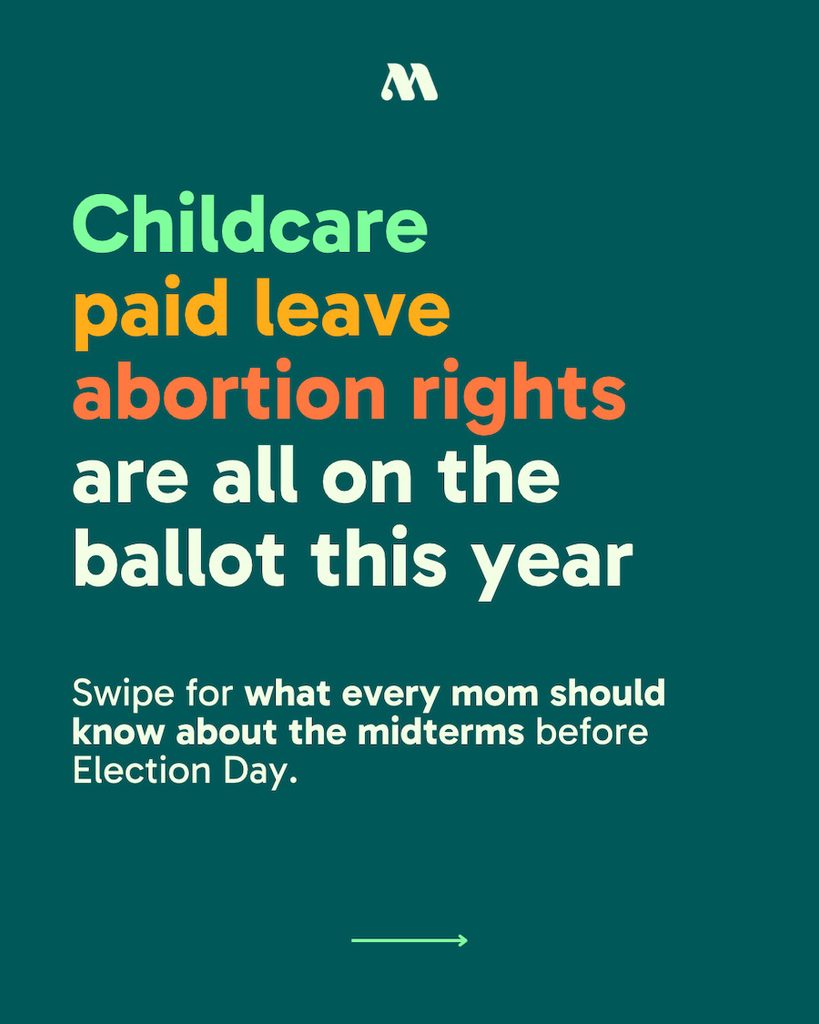
The biggest decisions for moms this year are being made down the ballot, in races for governor, state legislature, and local measures that could fund childcare in your community. We’re tracking 16 ballot measures every mom should have on her radar, from child care funding to paid leave to reproductive health. Read our full nonpartisan guide, then check your registration and make your plan at MamaVotes.
Pregnancy and Infant Loss Awareness Month
As Pregnancy and Infant Loss Awareness Month comes to a close, I want to share something personal. I’ve had five miscarriages, and after the first, I was back on a stage three days later, smiling through it, because that’s what we expect women to do. If you’ve lived this, too, you are not alone. Read my story, along with the support every mom who experiences a loss deserves.

Have Questions About Hosting a Watch Party? Attend a Virtual Office Hour on November 4
Curious about bringing No Country for Mothers to your workplace, school, or community, but not sure where to start? Join our virtual office hour next Wednesday, Nov 4, at 1 PM ET. In this informal 30-minute virtual session, our team will walk through how hosting works and answer any questions you have, whether you’re still deciding or already have a date on the calendar.
No Country for Mothers: Screenings Happening Near You
Check for a local screening in your city or join a virtual watch party.
- Delmont, PA, Nov 1, 5 PM at Holiday Inn Express Murrysville-Delmont — RSVP
- Schenectady, NY, Nov 2, 1:15 PM at Mont Pleasant Branch Library — RSVP
- Owensboro, KY, Nov 2, 5:30 PM — RSVP
- Redding, CT, Nov 4, 5 PM at Mark Twain Library — RSVP
- Dover, DE, Nov 4, 5:30 PM at Early Childhood Innovation Center — RSVP
- Nashville, TN, Nov 4, 5 PM at Old School Farm — RSVP
- Stillwater, OK, Nov 4, 5:30 PM at The HUB Stillwater — RSVP
- Winston-Salem, NC, Nov 5, 5:30 PM at a/perture cinema — RSVP
- Emmaus, PA, Nov 5, 6 PM at Juxtahub — RSVP
- Ann Arbor, MI, Nov 5, 6:30 PM at Recess Cafe — RSVP
- Bronx, NY, Nov 5, 7 PM at Riverdale Neighborhood House — RSVP
- Seattle, WA, Nov 5, 5 PM at Seattle University — RSVP
Want to host your own? Head to our Host Hub for all the info you need to set up your event.

Happy Halloween: Brace Yourselves
Halloween is Saturday. Daylight saving time ends Sunday. Good luck out there, moms.
Speaking truth to power has never been comfortable, and it was never supposed to be. The 2027 budgets are being written right now, and the people who show up with data are the ones who end up shaping what gets funded.
With the data to back it up,