
Last week, I wrote about the moment we almost built a national child care system and how quickly that possibility slipped away.
It’s one of those decisions that feels far away until you realize how much of today’s reality traces back to it. Because when we didn’t build that system, the burden didn’t disappear. It just shifted. Onto families. Onto mothers.
And once that pressure shows up in real life — when the math stops working, when the cost of care doesn’t line up with what a job pays, when something has to give — there’s always a second question that follows.
Who is responsible for this?
The Great Distraction: The Welfare Queen
In the 1970s, Ronald Reagan began telling a story on the campaign trail about a woman in Chicago named Linda Taylor.
He didn’t describe her in abstract terms. He told it like a scene.
A woman driving a Cadillac. Wearing furs. Living well off the system. Using dozens of aliases to collect welfare checks under different names, gaming the government at every turn.
You could picture her. And once you could picture her, it became easy to believe she represented something larger.
Here’s the truth though: Linda Taylor did commit fraud. She was prosecuted and convicted. But the version of her that traveled across the country was something else entirely. The scale of what she did was exaggerated, and her case was extraordinarily rare. She was not the norm. She was the exception.
That part didn’t travel.
What spread instead was the image of the “welfare queen.” And over time, that image hardened into something bigger: a racialized symbol that was projected onto millions of mothers, shaping how they were seen regardless of their reality.
What Was Actually Happening
While that story was gaining traction, families were navigating a very different reality.
The 1970s wasn’t a stable time in the American economy. It was the decade that would come to be known as the Great Inflation.
By 1974, inflation had surged into double digits. The stock market had lost roughly a third of its value. Unemployment climbed above 7%. And as the Federal Reserve moved to rein in inflation, interest rates rose sharply, eventually pushing mortgage rates into the double digits before peaking at nearly 19% in 1981.
More women were entering the workforce. By 1975, nearly half of mothers with school-aged children were working, yet many were concentrated in low-wage jobs with little stability and no benefits.
And then there was child care.
It remained largely inaccessible. In 1971, when Congress passed the Comprehensive Child Development Act, it was estimated that millions of children needed care that simply didn’t exist — one of the clearest signs that the system hadn’t caught up to how families were actually living.
So families did what families do. They pieced it together.
By the mid-1970s, more than 10 million Americans were relying on Aid to Families with Dependent Children. Many households receiving the aid were headed by mothers, many of whom were working, but still not earning enough to meet basic needs.
This wasn’t a story about widespread abuse.
It was a reflection of something much more uncomfortable: the economy wasn’t working for families, and mothers were absorbing the gap.

Inflation dominated the political landscape in the 1970s—captured here by women and children marching through New York City in 1973 to protest soaring food prices.(Barrons/Keystone/Hulton Archive/Getty Images)
Redirecting Our Attention
During a time when the country was facing real economic pressure, the “welfare queen” narrative gave people somewhere to direct their frustration. It turned something structural into something personal. It offered a clear target.
Look over here, at the bad mother. Not over there, at the politicians not giving you support in the first place.
And as long as attention stayed fixed on her, there was less pressure to ask for anything to change.
Over time, that framing effectively narrowed the social safety net available to needy families.
Programs designed to help families meet basic needs came to be viewed with suspicion. Reducing benefits could be framed as responsible. Tightening access could be presented as fairness.
Helping families started to look less like solving a structural problem and more like enabling bad behavior.
It’s a subtle shift, but it matters. Because once support is seen through that lens, it becomes easier to pull it back without confronting the conditions that made it necessary in the first place.
The Pattern: Then and Now
If you listen closely, you can hear the echo of that same story today.
Take the recent Minnesota child care fraud case.
The headlines come fast and sharp: millions of dollars misused, a network of providers under investigation, a system being taken advantage of.
Here’s what’s true: there was fraud, and it should be addressed. But the scale of that fraud is small compared to the size of the overall child care system and the number of families who depend on it every day. More than 12 million young children need regular care, and in every state, that care often costs more than housing.
At the same time, a full-time minimum wage job still leaves a parent below the poverty line.
That is the reality most families are navigating. But that part doesn’t make the headline.
What expands instead is the implication: that this isn’t an isolated case, but a reflection of something broader. That the system itself is suspect. That maybe the problem isn’t the gaps in child care, but the people using it.
And just like before, the focus begins to shift. Away from what families are up against, and toward who might be taking advantage.

The Motherhood Lectures: The Mommy Wars
Moments like the rise of the “welfare queen” don’t happen in isolation. They work because mothers have already been sold powerful stories about our role — stories that make it easier to justify systems that don’t support us.
I call these the “cons” of motherhood.
This month, I introduced The Motherhood Lectures, a series I recently delivered at NYU Law’s Birnbaum Women’s Leadership Center that traces these cons across American history.
This week’s lecture looks at the “Mommy Wars” and how these divisions show up at the exact moments when mothers get close to asking for something more.
You can see it in the way we’re so often split into opposing camps. The trad wife and the girl boss. The mother who breastfeeds and the one who uses formula. Vaccinated vs. unvaccinated. Public school vs. homeschool.
Different choices, different realities, but framed in ways that invite comparison, judgment and distance.
And while we’re focused on each other, the question of why motherhood feels so unsustainable in the first place quietly fades into the background.

American Motherhood Stories
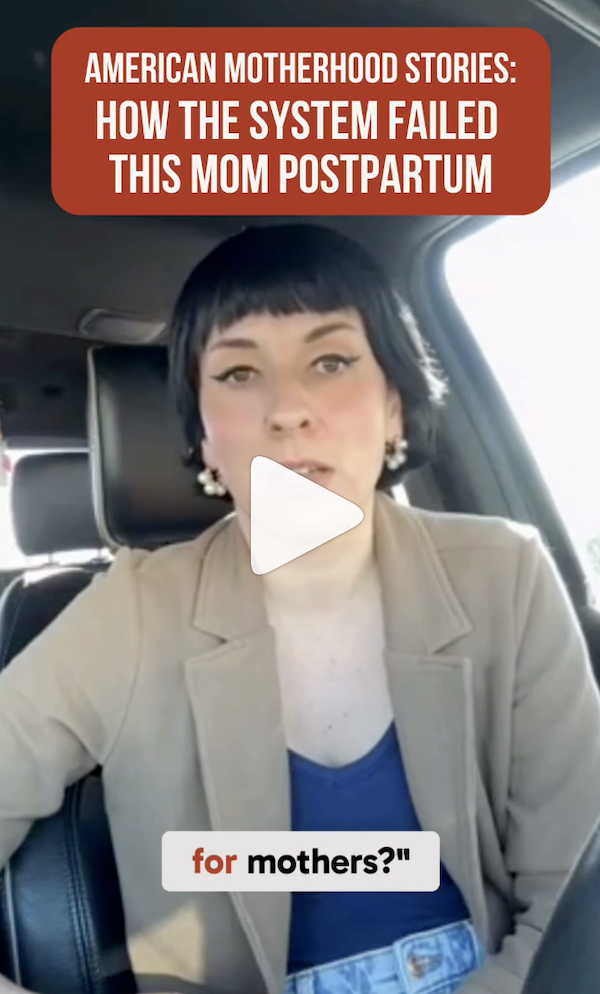
Some motherhood stories are harder to tell.
The ones where you don’t feel at home in your own body. Where you ask for help and it doesn’t come. Where your experience looks nothing like what you imagined.
Today, we’re sharing one of those stories submitted by a mom in our community.
Postpartum depression, anxiety, and psychosis are real. They are common. And they are not personal failures. Yet too many moms are left to carry this alone.
And they shouldn’t have to. Because the more we tell the truth about what motherhood is really like, the faster we can change it — shaping a culture and the policies that actually support moms.
Share your story. If you submit it by the end of April, you’ll become an Associate Producer on our upcoming documentary — and have your name in the film credits when it premieres this June.
Your story matters and helps other mothers feel less alone in the day-to-day struggles of motherhood.
In Case You Missed It
This Is What Advocacy Looks Like: Virginia Passes Paid Leave
We did it! A few weeks ago we shared an opportunity for our followers to take action and support paid family leave in Virginia. This week, the legislature passed this groundbreaking bill that would bring 12 weeks of paid leave to millions of Virginia families for the first time. Now, it’s heading to the Governor’s desk for her to sign into law. Thank you to everyone who took action to show support and win this victory.
A Win for Maternal Health in Wisconsin
Wisconsin just took an important step for maternal health. Governor Tony Evers signed a bill extending postpartum Medicaid coverage from just 60 days to a full year after birth. That means thousands of new moms — especially those at highest risk for complications — will have continued access to care during one of the most vulnerable periods of their lives. It’s a reminder that when we invest in mothers, we save lives.
When we stop turning on each other and start telling the truth about what mothers are up against, everything changes. That’s how we build the kind of country families have always needed.
Stronger together,
Reshma Saujani