
Every March, during Women’s History Month, we celebrate women’s strength. We tell stories about pioneers, progress, and barriers broken. And don’t get me wrong — those stories matter.
But strength doesn’t always look like a headline. Sometimes it looks like getting everyone out the door in the morning, remembering the field trip forms, answering Slack messages while helping with homework, and keeping track of the million tiny details that hold a family — and often a career — together.
If you’re a mom reading this, you know exactly what I mean.
And if we’re honest, motherhood in America has required a particular kind of strength and resiliency for a long time.
Which raises a question I’ve been thinking a lot about: why have mothers needed so much strength and resiliency in the first place?
It’s easy to assume the pressures moms face today are simply the natural evolution of modern life. Life got busier. Parenting got more complicated. Technology keeps us constantly connected to everything.
And somewhere along the way, mothers ended up carrying the load — balancing work, caregiving, and the invisible labor that keeps families running.
But the truth is something different. Modern motherhood didn’t simply evolve. It was shaped by design.
Over decades, cultural narratives and political decisions layered expectations onto mothers without removing the old ones.
That’s why throughout March, I want to unpack some of that history together. Each week in The First Word, we’ll look at a moment when expectations placed on mothers shifted and how those moments still influence the way America thinks about motherhood today.
Let’s start with one that quietly set the stage for so much of what came after.
The “Perfect Mother” Was Manufactured
During World War II, millions of women entered the workforce to support the war effort. By 1945, nearly 19 million American women were working — about one in three workers in the country.
But that shift didn’t happen in a vacuum.
Before the war, women did work. In fact, about a quarter of them were in the labor force, but cultural norms and legal structures kept married women and mothers largely out of paid employment. Only about 12% of married women worked, and just 7% of mothers were in the workforce. When women did work, it was usually in traditionally “female” jobs like typing, sewing, or domestic labor.
The war changed that almost overnight.
With millions of men deployed overseas, the country needed workers. Suddenly it became possible for married women and mothers to move into jobs that had long been reserved for men. Women stepped into factories, shipyards, and manufacturing plants for the first time.
It was the era of Rosie the Riveter, the cultural icon urging women to roll up their sleeves and help keep the country running.
The federal government even created the first large-scale publicly funded child care centers. For a brief moment, American culture and policy aligned to make working motherhood possible.
But when the war ended, that alignment disappeared.
Jobs were reclaimed by returning soldiers, wartime child care programs were dismantled, and a powerful new cultural narrative began to take hold. The ideal American mother, we were told, was at home.
Selling the Perfect Mother
Throughout the 1950s, ads, TV, and pop culture promoted a very specific image: the cheerful suburban housewife, perfectly coiffed, fulfilled by caring for her family and managing the household.
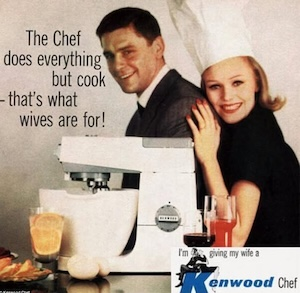
1961 Kenwood Chef Print Ad
This was the era when the idea of the nuclear family became the American ideal, and shows like Leave It to Beaver regularly depicted the same formula: a breadwinning father, a stay-at-home mother, and neatly behaved kids gathered around the dinner table each night.
It all looked effortless. Almost suspiciously so.
This wasn’t just culture reflecting reality. It was culture actively shaping it — selling Americans a vision of motherhood that looked polished, effortless, and entirely centered in the home.
But reality didn’t stay frozen in that moment.
Families increasingly needed two incomes. Women returned to the workforce. By 1960, nearly 40% of women were working again, and by the end of the decade nearly half of all married women were working outside the home.
Soon mothers were expected to do both: earn a paycheck and embody the image of the perfect homemaker.
Perfect Mother 2.0
Today, the majority of moms with kids at home are part of the labor force. And yet that post-WWII cultural blueprint never fully vanished. It lingered, quietly shaping how mothers judge themselves and how society judges mothers.
If anything, the pressure has taken new forms. Where glossy magazines and black-and-white TVs once promoted the image of the “perfect mother,” today social media feeds, parenting blogs, and the endless scroll of curated family life amplify that same ideal in new ways.
Now the “perfect mother” is expected to succeed at work, run a smoothly operating household, raise thriving children, and make it all look effortless.
Those expectations didn’t appear out of nowhere. They were built over time.
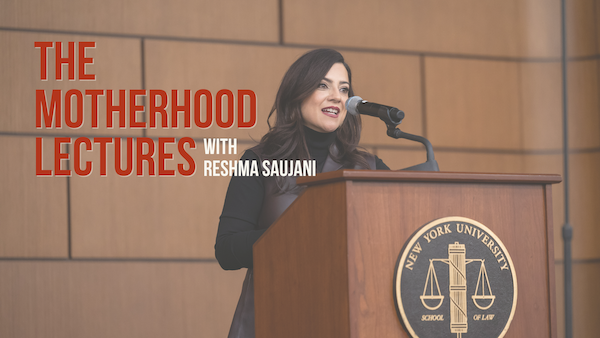
The Motherhood Lectures: The Cons We’ve Been Sold
As we unpack these moments throughout March, I want to zoom out for a second.
Because none of these moments happened in isolation. Each one added another challenge for mothers. Another rule. Another pressure point. And over time, those expectations kept stacking until we arrived at the version of motherhood so many of us are trying to survive today.
But the more I’ve been digging into the history of motherhood in this country, the more I’ve realized something else.
These moments didn’t just happen to moms. They worked because mothers had already been sold a set of stories about our role.
Stories that sounded flattering. Patriotic. Even empowering.
But underneath, they were doing something else.
They were convincing mothers that the pressure was normal. That the sacrifice was noble. That if all of this felt overwhelming, the problem must be us.
Lately, I’ve started calling these stories the “cons” of motherhood. They’re the narratives that helped keep mothers overworked, divided, and too busy blaming ourselves to question the system that produced all of this in the first place.
Once you start seeing the cons, you can’t unsee them.
That realization led me to create The Motherhood Lectures, a new series I recently delivered at NYU Law’s Birnbaum Women’s Leadership Center.
In the lectures, I trace these cons back through American history, looking at the moments where motherhood was deliberately shaped by political, cultural, and economic forces.
The first lecture, The Civic Duty Con, explores one of the earliest examples.
It tells the story of how, from the earliest days of this country, women were told their highest civic duty was raising virtuous sons for the republic — giving mothers enormous responsibility for shaping the nation while denying them real power to shape it themselves.
If you want to understand how some of the expectations we still carry today took root in the first place, this is where the story begins.
Mark Your Calendar

We’re Live Tonight: Moms, Democracy & What’s at Stake
Tonight, we gather.
Moms from across the country (and around the world!) are logging on at 7 PM ET tonight for a virtual conversation about our elections and what they mean for our families.
If you haven’t registered yet, there’s still time to grab your spot.
Stories From Our Associate Producers
“I constantly imagine what our society would look like if women were truly supported. Imagine what we could accomplish if we had proper care, proper pay, and proper leave. Instead, far too many women are forced to funnel nearly their entire income directly into childcare just to remain in the workforce.”
-Ashley Acay, First-time mom and SPHR
Recently, Ashley Acay, a mom from San Francisco, shared her story about American motherhood and became an Associate Producer on our upcoming documentary.
Ashley’s story is exactly why we launched this campaign. Mothers across the country are speaking up about what modern motherhood really looks like, and helping ensure those stories are part of this film.
Becoming an Associate Producer is simple. You can share your motherhood story, make a donation, or sign up to host a screening in your community.
Associate Producer Referral Challenge
We’ve launched an Associate Producer Referral Challenge through March 27, and we’d love your help growing this movement.
If you’re already an Associate Producer, invite the moms in your life to share their story or host a screening and become an Associate Producer, too. Just have them list your name in the “Who Referred You?” field of their submission form.
Refer 10 moms and you (or your organization) will be recognized for helping bring more voices into the film.
Making Headlines
Check out what people are saying about Moms First in the news:
- How Reshma Saujani’s Viral Moment Led to a Win for Affordable Childcare (TIME)
- A Simple Way to Cut Employee Turnover: Federal Child‑Care Tax Credits Explained (Inc)
Once you start seeing how motherhood in America was constructed, a lot of things begin to make more sense. And once enough of us see it clearly, we can finally start changing the systems that made it this hard in the first place.
Looking to history so we can change the future,,
Reshma Saujani