
After World War II, American culture promoted a very specific image of family life: a breadwinning father, a stay-at-home mother, and children gathered neatly around the dinner table each night.
But by the late 1960s, that model was already beginning to crack. Families increasingly needed two incomes, and by 1970, nearly one in four children under six had a mother who was working.
Mothers were an undeniable part of the workforce. The question was whether the systems around them would adapt.
For a brief moment in 1971, it looked like they might.
The Day We Lost Universal Child Care
In 1971, Congress passed the Comprehensive Child Development Act, one of the most ambitious child care proposals in American history. The bill proposed creating a national network of federally supported child care centers that would provide affordable care and early education for working families. It would have established quality standards, expanded early childhood programs, and helped families access reliable care during the years before children start school.
And here’s the part that surprises people today: the bill passed Congress with bipartisan support.
Even President Richard Nixon appeared supportive of expanding early childhood programs. In a 1969 message to Congress, he said, “So crucial is the matter of early growth that we must make a national commitment to providing all American children an opportunity for healthful and stimulating development during the first five years of life.”
For a brief moment, the US stood on the verge of building the kind of child care infrastructure that many developed countries now take for granted.
But President Nixon vetoed the bill.
So why did he change his mind?
Because somewhere between Cold War paranoia and a looming reelection campaign, child care got rebranded as communism.
“Family Values”
Opponents quickly reframed the debate. Instead of discussing child care as workforce infrastructure — something that would allow parents to work while their children received early education — critics began portraying the proposal as a threat to the American family.
They warned that government-supported child care would lead to too much government involvement in family life and weaken the nuclear family. Some claimed it would lead to what they described as the “communal raising of children.” In the middle of the Cold War, critics even compared universal child care to Soviet social policy.
That framing proved politically powerful. But it also obscured what was really happening.
As Nixon prepared for the 1972 presidential election, he faced pressure from the conservative wing of his party. His planned diplomatic opening with China had angered many on the right, and critics were questioning whether he remained aligned with traditional conservative priorities.
The child care bill suddenly offered a convenient opportunity.
By vetoing the legislation under the banner of protecting “family values,” Nixon was able to signal loyalty to his conservative base and consolidate support ahead of the election.
The veto wasn’t primarily about child care policy.
It was about consolidating political power.
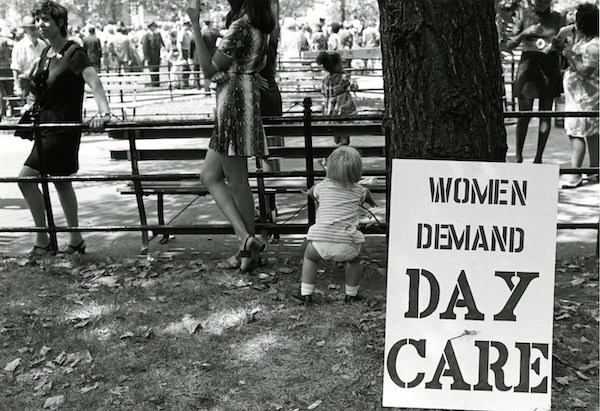
August 1970 | Women demonstrate for accessible child care at the First Women’s March.
Freda Leinwand, Courtesy of Schlesinger Library, Radcliffe Institute, Harvard University
The System That Was Never Built
The consequences of that decision have lasted far longer than the politics of the moment.
Rather than adapting policy to support the growing number of working mothers, the federal government effectively reinforced an older expectation: that families should still function as if one parent — usually the mother — were home full time.
Today, nearly 7 in 10 mothers with children under six are part of the U.S. workforce and dual-income households are the norm. Child care costs rival some of the biggest household expenses parents face — costing more than housing in all 50 states and also outpacing college tuition in most.
When families can’t find or afford reliable care, the same pattern repeats itself: parents — most often mothers — scale back work, reduce hours, or leave jobs altogether to fill the gap.
We’re seeing that reality play out again right now. Between January and August of 2025, more than 455,000 women left the U.S. workforce. And while layoffs accounted for some of those exits, the majority — 58 percent — were women who ultimately decided they couldn’t stay, citing structural pressures from lack of workplace flexibility and wages that simply don’t cover the soaring cost of child care.
Fifty Years Later: What Has Changed in Washington?
After Nixon’s veto, Washington built a patchwork of smaller programs — tax credits, subsidies, and early childhood initiatives like Head Start. These efforts helped some families, but they never added up to a national child care system.
The pandemic offered a stark reminder of what that absence means. When schools and child care centers shut down, millions of women left the workforce almost overnight. For a brief moment, it seemed like Washington might finally act. The Build Back Better plan included the largest proposed federal investment in child care in U.S. history.
But the legislation stalled.
More recently, the 2025 tax reconciliation package included a $16 billion investment in child care–related tax credits to help families offset the cost of care. Those investments matter, but they still fall short of the universal system Congress once came close to creating in 1971.
What’s beginning to drive real change instead is happening at the state level:
- New York recently expanded child care access and affordability, following years of advocacy from parents, business leaders, and organizations like Moms First working to make child care a top economic priority.
- New Mexico became the first state in the nation to offer universal child care, proving that large-scale child care systems are possible in the US.
These state-level efforts show what’s possible when leaders treat child care as the economic engine it actually is.
But they also underscore a bigger reality: more than 50 years after Congress came within inches of creating a national child care system, the country is still trying to solve the problem one state at a time.

The Motherhood Lectures: The Institutional Con
Moments like Nixon’s veto didn’t happen in isolation. They worked because mothers had already been sold powerful stories about our role — narratives about sacrifice, morality, and responsibility that made it easier to justify systems that didn’t support us.
I call these stories the “cons” of motherhood.

Last week, I introduced The Motherhood Lectures, a new series I recently delivered at NYU Law’s Birnbaum Women’s Leadership Center that traces these cons across American history.
This week’s lecture looks at another moment when motherhood was quietly reshaped: the early 1900s campaign that pushed midwives — many of them Black women who had safely delivered generations of babies — out of maternal care.
Watch the full Motherhood Lectures to understand how those decisions still echo in maternal care today.
In Case You Missed It

Moms First 2025 Impact Report
For years, we’ve been making a bold bet: that if we change the story about moms in America — if we show that investing in mothers is smart economic policy — we can change the system.
Our 2025 Impact Report, From Proof to Power, shows what happens when those bets pay off. In 2025, we helped secure $16 billion in federal child care funding, drove historic state investments, scaled PaidLeave.AI nationally to help families claim the benefits they’re owed, and expanded the movement by bringing dads into the conversation through the Future of Fatherhood Summit.
These wins are the result of years of building momentum and they’re proof that when we refuse to accept the status quo for moms, real change follows.

Inc. 2026 Female Founders 500
A quick thank you to Inc. for including me on the 2026 Female Founders 500 list.
It’s an honor to be recognized alongside so many women who are pushing boundaries, building bold ideas, and proving that when women lead, the world moves forward.
The Latest on the SAVE Act
The SAVE Act is heading toward a major Senate showdown. Republican leaders are considering a marathon debate on the bill as pressure mounts to move it forward.
The legislation would function as a modern day “poll tax”, creating new barriers to voter registration and eliminating the ability to register online, by mail, or at voter registration drives.
Experts say the legislation would impact millions of women who’ve changed their last names and may not have documents that match their current legal name.
When the rules of democracy shift, moms often feel it first. That’s exactly why we hosted a Motherhood Live conversation last week about what’s happening to our elections right now and why mothers’ voices matter in moments like this.
If you missed it, you can watch the full conversation here.
And if you’re ready to take action, you can write your senators through this quick form from When We All Vote.
Let’s Close the Parenting Tech Gap
We’re excited to share that Moms First has joined the Parent Gap campaign: a movement to close the parenting tech gender gap and encourage more dads to actively engage with family management tools.
Research shows that family apps are used by 95% women, creating invisible labor and less shared accountability. Together with Bumo, Fair Play, and other family-tech leaders, we’re working to change that.
Take the pledge and commit to inviting your partner to share the parenting load.
History reminds us that the systems around families didn’t just happen — they were built through choices. And the good news about choices is that they can always be changed.
To leading the change we want to see,
Reshma Saujani