
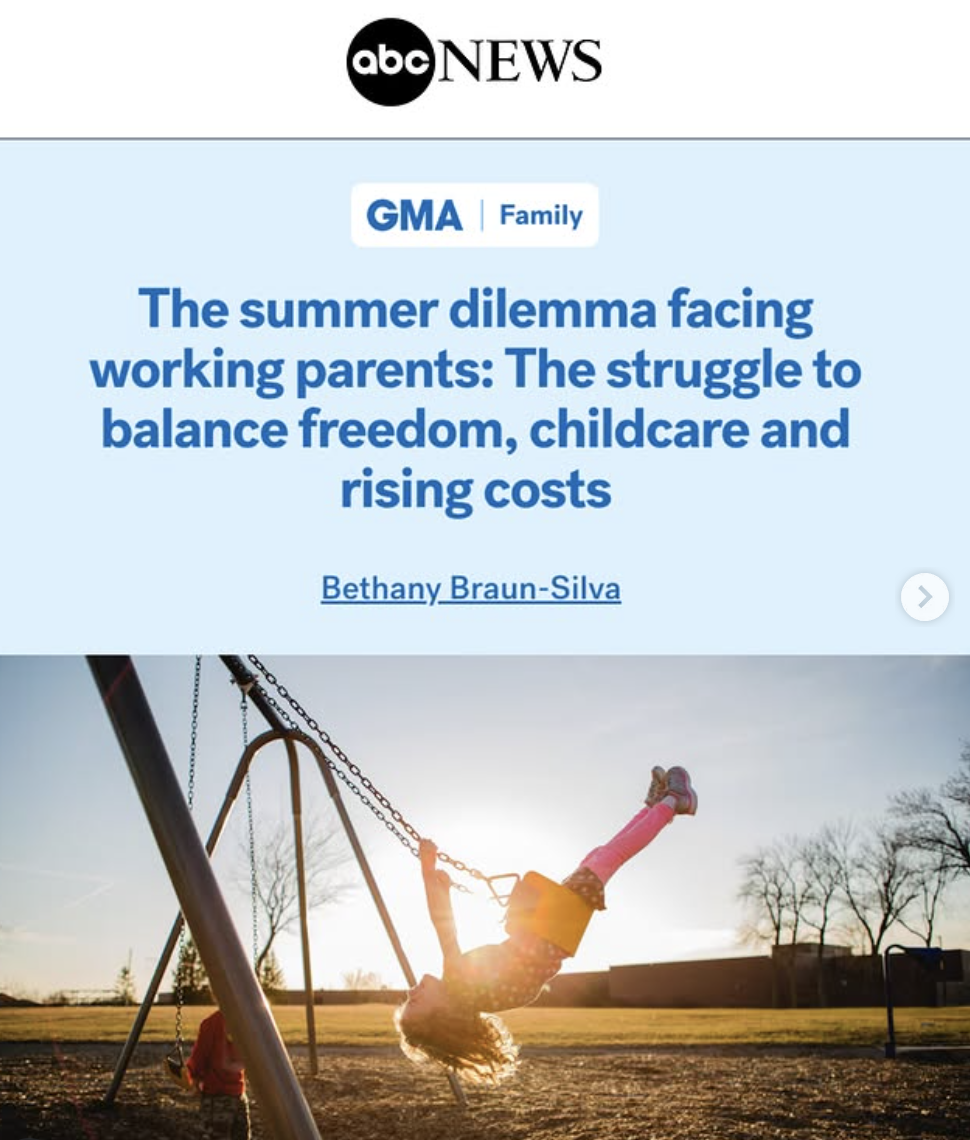
If summer feels like a second job, that’s because for most moms, it is.
It starts in January with an alarm going off. Not to remind you of a work meeting or a flight to catch, but an alarm set for your kid’s camp registration. You know, that rare camp with extended care, the one that runs early enough and late enough to make a workday possible. Miss that registration window and summer becomes what it usually is anyway: a patchwork. A few weeks of expensive specialty camp, a week at grandma’s, a handful of PTO days where you’re still answering Slack by the pool, and if you’re lucky, an actual vacation.
This is the math working moms do every year. Not because they’re disorganized. Because the system gives them no other choice.
And while families are living the summer child coverage scramble right now, the federal government is debating whether to zero out the only funding stream dedicated exclusively to summer and afterschool programs. Not cut it. Zero it out.
This is not a coincidence. It’s a policy choice.
The Numbers Don’t Lie
Let’s start with what this actually costs. Sixty-six percent of parents struggle to afford summer childcare, with nearly the same share going into debt to cover it. Ninety percent of working parents lose sleep over summer childcare planning. The average family spends more than 20% of household income on childcare, nearly triple the federal affordability benchmark of 7%. Specialty camps run $500 to $1,500 a week. Even community programs start at $200.
This isn’t sticker shock. This is a system working exactly as designed, just not for us.
And this spring, the White House proposed, for the second straight year, to eliminate the 21st Century Community Learning Centers program, the only dedicated federal funding stream for afterschool and summer learning. Nearly 1.4 million children across 10,000 programs in every state depend on it. The proposed replacement: a single “Make Education Great Again” block grant at a fraction of the current funding, with few regulated uses. Congress has pushed back, but the Senate vote is still ahead.
The Calendar Was Never Built for Us
Here’s something we don’t talk about enough: the school calendar was designed around the harvest season. It was built for an agrarian economy that no longer exists, and we never rebuilt the workplace or the care system around it.
The 10am camp start. The 3:30pm pickup. The gap between when one program ends and the next begins. These aren’t inconveniences. They’re design failures. And they expose what’s true all year long: modern work life depends on schools functioning as our most reliable form of childcare. When school ends, the whole scaffolding collapses.
That collapse doesn’t hit everyone the same way. For low-income families, Black and Brown parents, and families of children with disabilities, summer doesn’t just expose the gaps. It falls into them. The resources to patch the patchwork are not equally distributed. The January alarm is a privilege not everyone can afford to set.
And that alarm isn’t neurotic. It’s a rational adaptation to an irrational system. And the programs that make that adaptation possible, the subsidized summer care, the afterschool centers, the community learning programs, are now under direct federal threat for the second year in a row.
The PTO Tax Is Real
So many working moms are not taking summers off. They are spending their vacation days patching holes the system left open. The camps, the babysitters, the favors from neighbors, the mornings at grandma’s, the burned PTO: none of that is simply resourcefulness. That is what filling a policy vacuum looks like.
Coordinating and affording summer care has become a full-time job. One that almost always falls on moms. Among full-time working parents, mothers do 1.6 times the childcare and household labor of fathers. Summer didn’t create that gap. Summer just makes it impossible to ignore.
To every employer reading this: flexibility and grace are not perks. They are a baseline, especially now, as companies push workers back into rigid office schedules with no acknowledgment of what summer actually demands from working parents. Remote options, flexible hours, grace around school schedules and summer gaps: these are leadership decisions. They don’t require an act of Congress. They require an act of will.
Childcare Is an Economic Imperative
When childcare is unavailable or unaffordable, parents cannot work. When caregiving falls disproportionately on women, economic inequality deepens. This is not a women’s issue. It is an economic justice issue, a public health issue, a racial justice issue.
The numbers bear this out. Stagnant federal funding already means 24,000 fewer children will have access to care in 2026. If nothing changes, that number nearly doubles within two years. These aren’t abstractions. These are children whose parents cannot get to work. Cannot pay rent. Cannot build anything.
In January, the Trump administration threatened to freeze childcare funding to five states outright: California, Colorado, Illinois, Minnesota, and New York, while simultaneously requiring 45 other states to justify every dollar before drawing down any funds at all. A 50-state story dressed up as a fraud investigation.
And yet some states are showing us exactly what’s possible when leaders treat childcare as the economic necessity it is. New Mexico, New York, Vermont: they are proving that investment works. Full implementation of year-round care programs like 2-K and 3-K in New York City alone would lift 12,000 New Yorkers out of poverty annually.
The contrast is the point.
A Fighting Chance
Most parents aren’t asking for perfection. They’re asking for a fighting chance.
And right now, that chance is on the line in the United States Senate.
The 21st Century Community Learning Centers program has survived two consecutive attempts to eliminate it because people showed up and said no. Parents called. Advocates organized. Bipartisan members of Congress listened. That is not nothing. That is proof that this fight is winnable, but only if we keep fighting.
So here is what I need from you today. Contact your representatives. Tell them to fully fund afterschool and summer learning. Tell them that 1.4 million kids and the parents who depend on those programs are watching.
And then tell us your story. What does your summer actually look like this year? The 5am panic spiral. The camp that cost more than your rent. The PTO you burned just to cover a Tuesday. We are collecting these stories as part of our American Motherhood Tour and our documentary No Country for Mothers . Because here’s the truth: data moves policy, but stories move people. Every experience you share becomes part of the case we are building for the country moms deserve.
Most families aren’t asking for a revolution. They’re asking for a government that shows up the way they do — every single day.

Screenings Happening Near You
Over 250 No Country for Mothers watch parties are already on the books nationwide, with more added every day. Find one near you or host your own:
- Bethesda, MD, June 26, 6:30-9:30 PM at Pink Moon — RSVP
- Sacramento, CA, June 28, 1-3PM at Bike Dog Brewing East Sac — RSVP
- Austin, TX, June 30, 2-5PM at Austin Doula Care — RSVP
- Washington, DC, June 30, 6:30-9PM at Alamo Drafthouse Cinema — RSVP
- Glendale, AZ, June 30, 5:15-8:30pm at Bellair Association of Parks & Recreation — RSVP
- Santa Barbara, CA, June 30, 5:30-8:30 PM at Santa Barbara Wine Collective — RSVP
NYC Caregiver Survey
If you have a child under five and live in New York City, we need you.
Researchers are studying how families make childcare decisions in NYC, and your experience matters. The survey takes just a few minutes, closes June 26th, is available in English and Spanish, and everyone who completes it is entered to win one of five $200 gift cards. Take the survey today.

Check out what people are saying about Moms First in the news:
- No Country for Mothers’ Proves American Moms Deserve Better Choices Than Tradwife or Girlboss (In Style)
- Trad Wife vs. Girl Boss? Reshma Saujani Says It’s All a Distraction (PBS)
You have been solving an unsolvable problem for long enough. It’s time the people in power started doing their part. We’re not letting them off the hook — and we’re so glad you’re with us.
Here’s to a summer where you finally catch a break,
