
There’s a term for people raising kids and caring for aging parents at the same time, and it’s been sitting in our vocabulary so long we’ve stopped noticing how strange it is. “Sandwich generation.” As if this were a snack. As if there were a lunch break in it anywhere.
More than half of American adults in their 40s are currently raising a child under 18 while also caring for a parent 65 or older, according to Pew Research Center. Nearly half of all adults aged 40 to 59 are living some version of this dual-care life. And 60% of the people actually doing the caregiving are women, obviously.
This isn’t a hard season. It’s the default condition for a huge share of this country’s mothers. And almost nobody built anything to support it.
What “Pay Yourself First” Leaves Out
A Forbes piece went viral earlier this summer, aimed squarely at women doing exactly this. The advice itself was solid: automate your savings, set real boundaries with adult kids who still expect a check, get your parents’ estate paperwork handled before a crisis forces it. I’d tell you the same thing. I’m not here to pick that article apart.
But read it closely and you’ll notice what’s missing. Not one line about paid caregiver leave. Not one mention of employer policy. Not one acknowledgment that the entire system assumes someone, and let’s be honest about who, will absorb this work for free.
That’s the sleight of hand. Frame a policy failure as a budgeting problem, and suddenly the fix is discipline instead of legislation. “Pay yourself first” is genuinely good advice. It’s just good advice inside a system built to make it nearly impossible to follow.
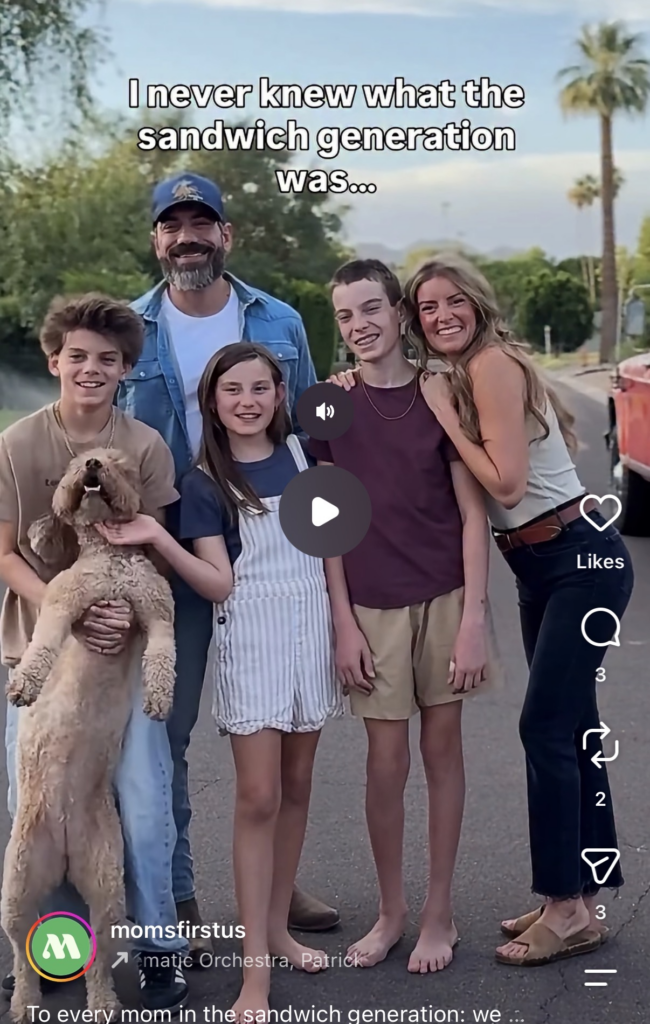
Thank you to @adriannelentine for opening up about what it really looks like to raise your kids and care for your elderly parent as part of the sandwich generation.
The Real Numbers
Let’s look at the scale of it, because it’s very real and the mental and physical toll it is taking on women is even greater: 64% of working women in the sandwich generation report being at a breaking point, according to Cleo’s 3rd Annual Family Health Index. Not stressed. Not stretched thin. Broken.
This isn’t a small or shrinking group either. Nearly half of adults aged 40 to 59 are navigating this exact dual-care role, and women are the ones carrying most of it, losing real income to reduced hours while propping up a long-term care system that barely exists for ordinary families.
This is mainstream. It’s the majority experience for women in this age bracket, not a hard-luck outlier.
The Policy Gap, and How Far It Reaches
Here’s the actual news, the part that should make you angry: only 29% of employers offer any family caregiver leave at all, and most of that amounts to less than three weeks of paid time off. Three weeks. For a job that has no end date.
And even if every employer in America fixed that tomorrow, it still wouldn’t reach the stay-at-home mom who isn’t on anyone’s payroll: the one running her household full time while also caring for her parents around the clock, with no employer to grant her leave in the first place. This can’t be solved company by company. It needs a floor set by policy, not a perk handed out at HR’s discretion.
There is a live legislative moment worth naming, and it’s worth giving credit where it’s due. A bipartisan pair of bills introduced in Congress this spring, the Improving Retirement Security for Family Caregivers Act and the Catching Up Family Caregivers Act, would let unpaid caregivers contribute the full annual Roth IRA maximum even on reduced income, and make enhanced catch-up retirement contributions for five years once they’re back to earning. That’s lawmakers finally admitting caregiving wrecks retirement savings.
But look at what the bills actually do. They help you save more once you’re already back to work. They do nothing for the leave gap while you’re still in it, right now, this week. Both things can be true: this is real momentum, and it’s still nowhere near the actual fix.
Unpaid caregiver labor in this country is valued at roughly $1 trillion. A trillion dollars of labor, done for free, absorbed by whoever happens to be closest. That’s not a gap. That’s a business model.
And it’s worth sitting with how far this gap really reaches. A New York Times story published just this week reported that an estimated four million American children are providing care for a sick, disabled, or elderly family member, a figure the piece itself says likely undercounts the real total. When there’s no system and no support, the caregiving doesn’t disappear. It cascades down to whoever’s left standing. Sometimes that’s the youngest person in the house.
Solidarity, Not Self-Discipline
Lawmakers are starting to notice, and the bipartisan movement on retirement security for caregivers genuinely matters. I’m not going to wave that away. But “help you save more later” is not the same thing as “support you now.” Until paid caregiver leave is standard, families will keep being told to solve a policy failure with better personal discipline.
You are not failing at financial planning. The system was never built to plan around you.

Knowing this system is broken doesn’t have to mean navigating it alone.
- Know your rights. The FMLA offers some unpaid eldercare protection today, limited as it is. Use our tool, PaidLeave.AI to see what leave protections actually apply to your situation.
- Tell us what this looks like for you. As part of the American Motherhood Tour, we’re collecting stories from caregivers living this exact reality.

Head Start Is on the Chopping Block. Here’s What You Should Know.
Head Start turns 61 this year. It’s served an estimated 40 million kids since 1965, and for a huge number of families, it’s the only reason childcare and early education are within reach at all.
But Head Start was never just about access. It worked because of quality: specific, enforceable standards that made sure “early education” actually meant something once a kid walked through the door.
Right now, federal regulators are proposing to strip most of those standards out. I’m not going to pretend this is a small technical update. Here’s what’s actually on the table:
- Classroom ratios go from a federal floor to a state guess. Right now, one teacher can care for at most four infants. Under this proposal, states set their own limits instead, often far looser ones.
- Teacher qualifications get gutted. Programs would be barred from even requiring credentials unless they can prove those credentials are necessary.
- Protections for kids with disabilities get hollowed out. The 10% enrollment commitment stays on paper, but the regulatory guidance that actually backs it up would be stripped back.
- More hoops for families to jump through. Enrollment would require more documentation to prove eligibility.
This isn’t about politics. It’s about whether the country still believes a program built to give low-income kids a fair shot deserves the standards that made it work.
What You Can Do Now
None of this has happened yet and all of it is still on the table.
You have until October 6 to say something about it, and this is one of the rare moments where your comment becomes part of the official public record. We need your voice!
Submit a public comment. It takes a few minutes, and it’s one of the few moments in this process where your voice is actually part of the record.
The advocacy organization, Start Early, has provided templates to make it easy to craft your comment. Visit their action center.
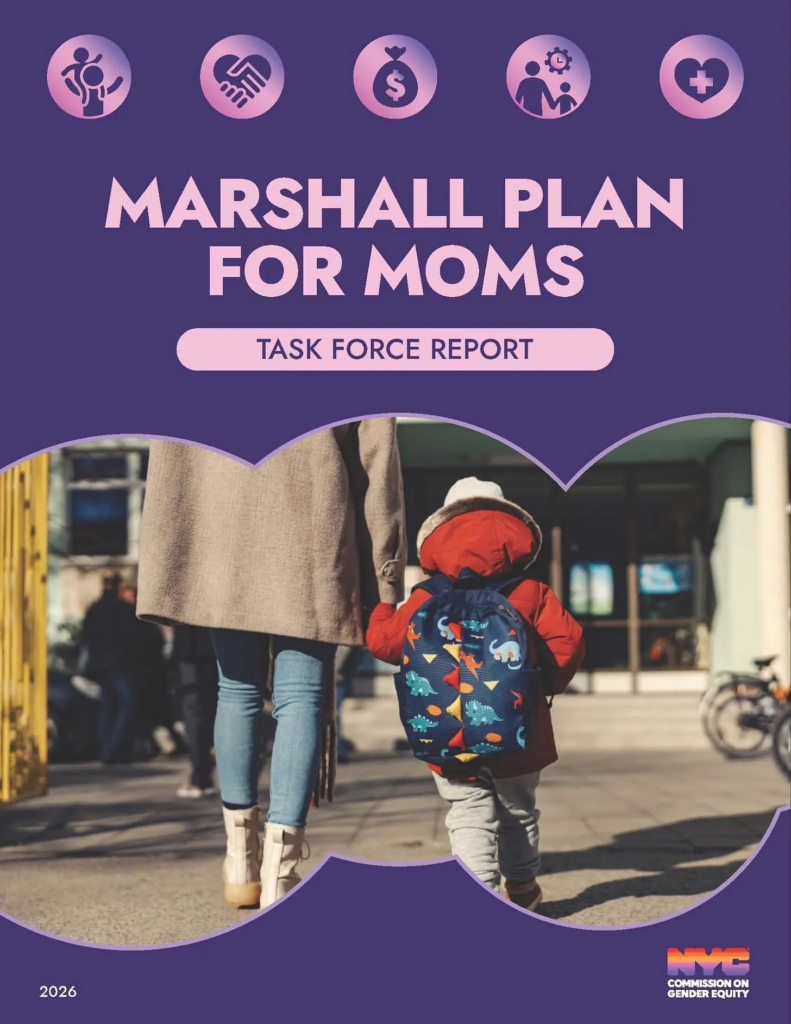
What Happens When School Starts, But Caregiving Doesn’t Stop
This week in my Substack, Here’s The Thing, I co-wrote an op-ed with Priya Nair, executive director of NYC’s Commission on Gender Equity, on what two years of the Marshall Plan for Moms Task Force taught us.
Back-to-school doesn’t end the childcare crunch. It just relocates it, to before- and after-school hours, holidays, and every gap families are still expected to fill themselves. This is what a real, year-round childcare system would actually require, and why I believe caregiving has to be treated as a shared public responsibility, not a private burden.
If we want a city where families can thrive, we must treat childcare as essential infrastructure.
Check out the joint op-ed and then read the Marshall Plan for Moms recommendations and add your voice to the call for a childcare system that works for families and caregivers year-round.
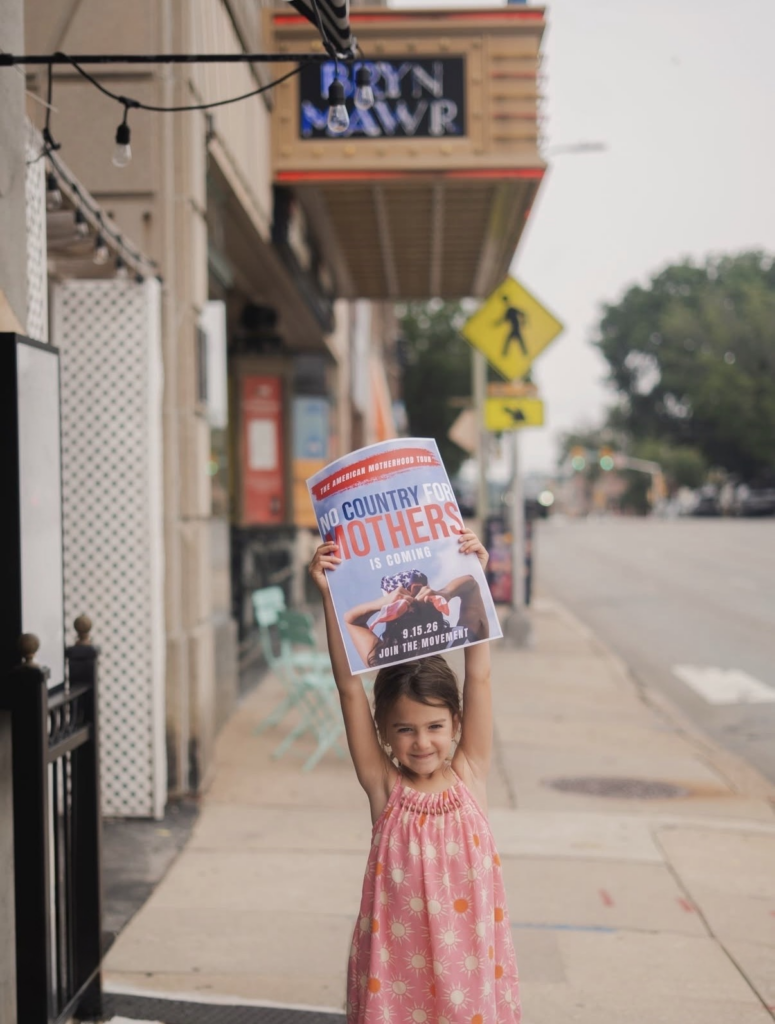
Host With The Most
Our Moms First community members are promoting their upcoming screenings in the cutest ways.
Check out the above event in Bryn Mawr, PA from The Wildflower Collective and Living Mindfully Therapy.
No Country for Mothers: Screenings Happening Near You
More than 600 screenings of No Country for Mothers are already scheduled in 47 states + DC and Puerto Rico. Find one near you, or attend a virtual screening.
- Virtual Screening (New York, NY), Aug 17, 9:30-11:30 PM — RSVP
- Virtual Screening (Brevard, NC), Aug 18, 2:30-4 PM — RSVP
- Arlington, MA, Aug 18, 6-8 PM at Robbins Library — RSVP
- Virtual Screening (Harrison, NY), Aug 19, 8:30-10:30 PM — RSVP
- Thousands Oaks, CA, Aug 19, 6-8 PM at Thousand Oaks Library (Newbury Park Branch) — RSVP
- San Francisco, CA, Aug 19, 6:30-8:30 PM at Sunset Commons — RSVP
- Wichita, KS, Aug 20, 7-10 PM at Artichoke Sandwichbar East — RSVP
- Le Mars, IA, Aug 20, 8-11 PM — RSVP
- Lee’s Summit, MO, Aug 21, 6:45-9 PM at Fillmore Chapel — RSVP
- Santa Cruz, CA, Aug 21, 7-9 PM at Rio Theatre — RSVP
- Olathe, KS, Aug 22, 10 AM-12 PM — RSVP
- Sandy Springs, GA, Aug 22, 1-3 PM — RSVP
- Virtual Screening (Harrison, NY), Aug 22, 2-4 PM — RSVP
- Chesapeake, VA, Aug 23, 2-3:30 PM at Chesapeake Central Library — RSVP
- Hobart, IN, Aug 23, 4-7 PM at First Unitarian Church of NW Indiana — RSVP
- Reno, NV Aug 23, 3-5 PM — RSVP
Want to host your own? Head to our Host Hub for all the info you need to set up your event.
You are not failing at planning. You’re succeeding at an impossible math problem the country refuses to fix: two full-time jobs, one paycheck’s worth of support, zero weeks of leave that actually cover it. That’s not a you problem, and until enough of us say so loudly enough, it’s going to keep getting sold to caregivers as one.
Not here for the lunch pun, here for the fix,
