
You know how moms are when a form comes home from school.
We don’t just sign it and toss it back in the backpack. We read it (ok, sometimes we skim it), but more often than not, we notice what’s missing. Because we’ve learned that when something doesn’t line up, we’re the ones who end up fixing it.
That’s exactly why what’s happening right now should catch our attention.
Small details are being rewritten in voting law. Not with sirens. Not with dramatic headlines. But with language like “election integrity” and “common sense reform.” It sounds technical. Responsible. Harmless.
It isn’t.
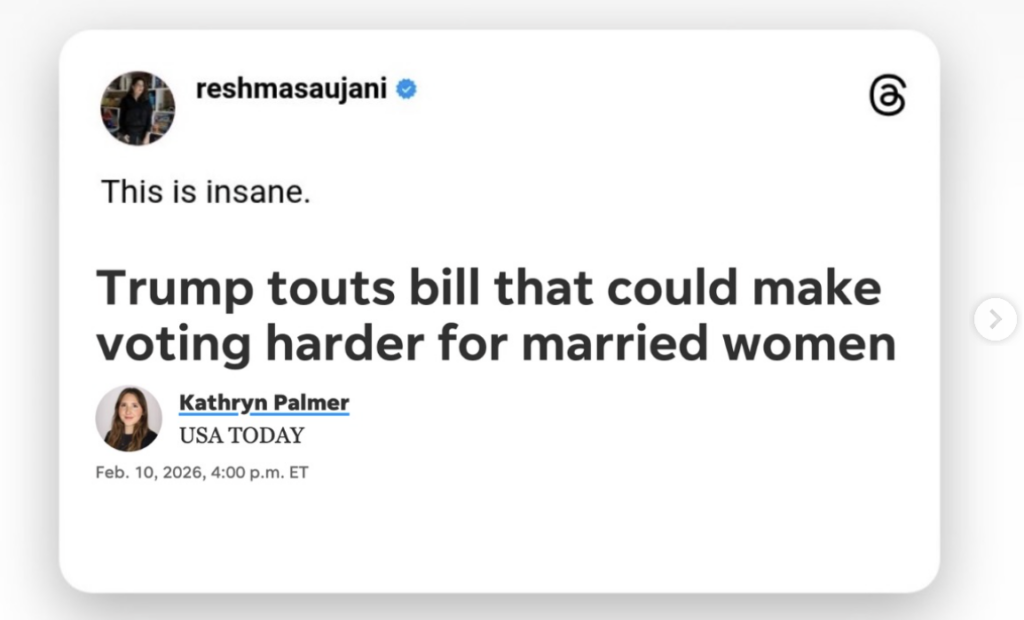
The House has passed the SAVE Act, which would require documentary proof of citizenship to register to vote in federal elections. On its face, that might sound fine. But here’s what that actually means: your voter registration would have to match official citizenship documents exactly.
Suddenly, that paperwork matters in a whole new way if you:
- Changed your name when you got married.
- Changed it back after a divorce.
- Have a birth certificate that says one thing and a driver’s license that says another.
At the same time, states are tightening voter ID requirements and registration rules under the banner of fraud prevention. There’s escalating rhetoric about ICE enforcement and military presence at polling sites. It’s being framed as security. But when voting becomes more complicated — or more intimidating — participation shifts.
Let’s be honest about something: widespread voter fraud in the United States is rare. Less than 1%. But barriers? Barriers are easy to build. All you need is paperwork. Or just enough friction that the process becomes harder for people who already don’t have extra time.
And moms do not have extra time.
This isn’t theoretical. It’s active legislation and it’s happening right now.
So let’s name it clearly. It’s disenfranchisement.
Disenfranchisement doesn’t always look like someone slamming a door in your face. Sometimes it looks like adding another lock. Another form. Another requirement. Over time, those layers don’t eliminate the right to vote; they just make it harder to exercise.
When Rights Narrow, Women Organize
Women know this story. And it’s not just because we were denied the right to vote until 1920, but because we fought for it.
It was women, many of them mothers, who organized, marched, endured arrest, and went on hunger strikes to win the 19th Amendment. Leaders like Susan B. Anthony, Sojourner Truth, and Ida B. Wells weren’t asking politely for inclusion. They were building movements. They were knocking on doors, organizing communities, and insisting that democracy expand to include them.
And when the amendment passed, that wasn’t the end of the fight.
For many Black women in the South, the right to vote remained blocked through literacy tests, poll taxes, and outright intimidation. During the Civil Rights Movement, Black women became the backbone of voter registration drives. Women like Fannie Lou Hamer didn’t just testify before Congress, they organized neighbors, opened their homes for meetings, and risked their safety so others could register.
Churches, kitchens, and living rooms became organizing hubs that pushed the country toward the Voting Rights Act of 1965.
And it didn’t stop in the 1960s. Organizations like the League of Women Voters continue to educate and mobilize women voters. And for decades, women have staffed election protection hotlines, served as poll workers, and led grassroots efforts to defend ballot access in their communities.
This has always been the pattern.
Rights in this country rarely disappear in one dramatic moment. They narrow. They tighten. They become harder to use — especially for people juggling work, caregiving, and everything in between.
But just as consistent as the tightening is this: women organizing in response and mothers mobilizing.
This Is Where It Gets Real
And here’s why this matters for us. Because voting is not some abstract civic exercise. It’s the lever behind everything:
- Child care funding
- Paid leave
- Reproductive autonomy
- Public school budgets
If fewer caregivers participate fully in democracy, policies move further away from families.
There’s also the very practical reality: name-change documentation disproportionately affects married women. According to Pew Research, nearly 80% of women in opposite-sex marriages take their husband’s last name. Fewer than 5% of men do.
Caregivers don’t have spare afternoons to track down documents or wait through extended lines. When bureaucracy expands, it never lands evenly. It lands on the women who are already doing the invisible work of holding everything together.
Prepared, Not Panicked
So what do we do?
First, check your voter registration status. Make sure your name matches your documentation. If you’ve changed your name, confirm everything aligns.
Second, call your Senators about the SAVE Act. You don’t need a perfect script. You can say: “I’m a constituent and a mom. Please oppose policies that make voter registration harder for eligible citizens.” Two minutes. That’s it.
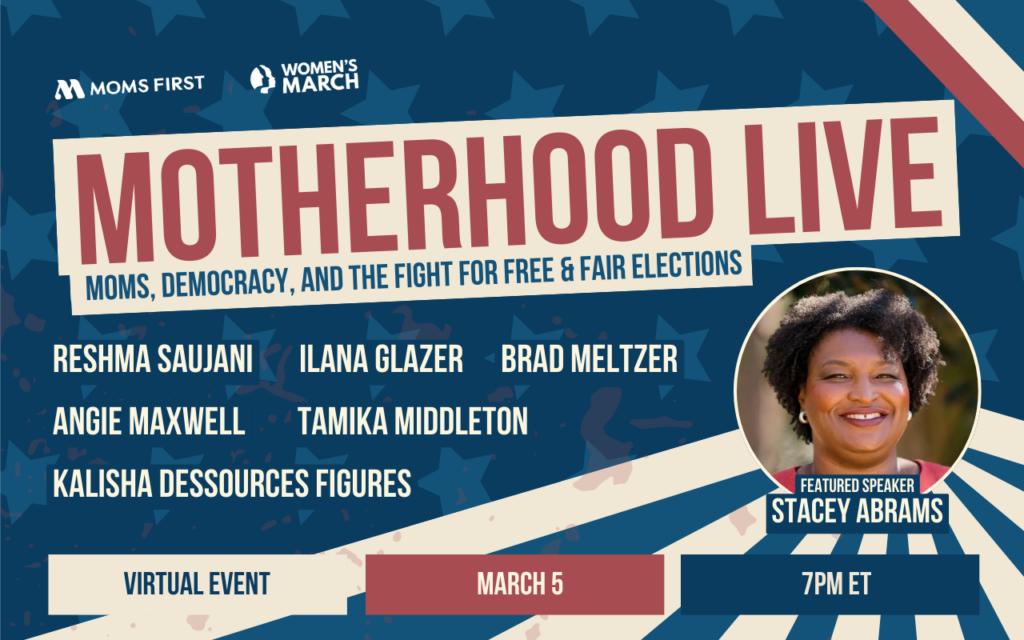
And third, join us for our upcoming webinar Motherhood Live: Moms, Democracy, and the Fight for Free & Fair Elections on March 5 at 7PM ET.
Voting rights activist Stacey Abrams will be joining us along with a powerful lineup of other panelists to break down what’s real, what’s rhetoric, and what comes next. This isn’t about fear. It’s about not letting something foundational quietly shift while we’re busy keeping everything else afloat.
Democracy Should Fit Real Life
Let me leave you with this.
This moment is bigger than one bill. It’s about whether voting continues to fit into real life — into packed calendars, school pickups, and back-to-back conference calls — or whether it becomes just complicated enough to push some of us out.
Moms have always been on the front lines of safeguarding democracy. We’ve organized. We’ve registered voters. We’ve marched. We’ve protected access before.
And we can do it again.
Moms hold families together. We can help hold democracy together too.
Action Center
Join Us for a Critical Conversation on Democracy
When voting rules change, moms feel it first. Because democracy isn’t abstract for us; it determines whether our kids’ schools are funded, whether our health care is protected, and whether our communities are safe and represented.
That’s why we’re bringing together an extraordinary group of leaders — Stacey Abrams, Ilana Glazer, Brad Meltzer, Tamika Middleton, Kalisha Dessources Figures, and Angie Maxwell — for a timely virtual conversation about what’s happening to our elections and what we can do about it.
Moms First is proud to partner with We Hold These Truths and Women’s March for this event that’s designed to leave you educated, grounded, and ready to show up.
In Case You Missed It
Virginia Is Almost There on Paid Leave
Big win this week in Virginia.
The Virginia House and Senate have passed legislation to establish 12 weeks of paid family and medical leave — a move that could bring paid leave to millions of families across the state.
It’s not law yet. Each chamber still needs to approve the other’s bill, and then it heads to the Governor’s desk. But this is major progress.
This moment is the result of years of advocacy from partners like Voices for Virginia’s Children and Freedom Virginia. And a huge shout out to the business leaders from our National Business Coalition for Child Care, including Etsy, Patagonia, and Bobbie, who’ve helped push this forward.
Now we need one more push. If you live in Virginia, keep emailing your lawmakers and urge them to get this over the finish line and send it to the Governor’s desk for signature.
If you don’t live in Virginia, share this with someone who does because state wins like this build momentum everywhere.
This is what progress looks like. Let’s finish it.
Making Headlines
Check out what people are saying about Moms First in the news:
- Op-ed: These small businesses hold the key to child care for New Yorkers (Crain’s New York Business)
Democracy doesn’t defend itself. It survives because ordinary people refuse to let it quietly narrow. We’ve protected our families before, and we can protect the right that protects everything else.
Let’s hold the line,
Reshma Saujani