
Help build a country that works for mothers
The Perfect Storm Nobody Warned Us About: When Postpartum and Perimenopause Collide
A few weeks ago, a mom pulled me aside after a film screening and said something that felt all too familiar to me. She’d been to three different doctors this year trying to explain how she felt:
“I just didn’t feel like myself. Something was off. I was so tired I couldn’t think straight. My thoughts were scattered and the simplest tasks seemed daunting to me.
But the doctors were dismissive and didn’t seem equipped to provide me with proper treatment.”
I’m about to turn 51. I have two young boys, ages 11 and 6. And if I’m honest, I spent the early part of my 40s feeling just like that mom. I assumed what I was feeling, the brain fog, the fatigue that sleep couldn’t touch, the sense that my own body had suddenly changed the rules on me, was just motherhood catching up to me. Nobody told me it might be two things at once: Postpartum recovery and perimenopause. Two conditions doctors are trained to look for one at a time, but almost never together.
Turns out I’m far from the only one in this position.
The Overlap Nobody’s Diagnosing
Births among women 35 to 39 are up 90% since 1990, and in 2023, births to moms 40 and older outnumbered teen births for the first time in US history.
That means more of us are hitting the postpartum window right as perimenopause starts unfolding in the background, often years before a missed period gives it away.
The Menopause Society’s large-scale study released this past July found that a third of women aged 35 years and older are unsure whether they’re even in perimenopause, with confusion peaking at 42% among women 40 to 44, the exact years many of us are raising toddlers. The top reason women gave: they couldn’t tell perimenopause apart from something else happening in their bodies, postpartum recovery included.
Women aren’t confused because we’re not paying attention to our own bodies. We’re confused because the medical system has routinely failed to provide women with adequate postpartum and perimenopause care, let alone at the same time.
America Fails Us Twice
Here’s what postpartum “care” looks like for most new moms in this country: one six-week checkup and then good luck.
Every high-income country included in the Commonwealth Fund study guarantees at least one home visit from a midwife or nurse within a week of childbirth, and guarantees at least 14 weeks of paid leave. Except the United States, which guarantees neither.
We are the only wealthy nation that sends new mothers home with nothing built in.
If postpartum care ends too soon, perimenopause care barely starts. A 2019 survey found that just 6.8% of graduating OB/GYN, family medicine, and internal medicine residents felt adequately prepared to manage a patient going through menopause.
And that neglect carries a price tag. A Mayo Clinic study found untreated menopause costs the US economy $26.6 billion a year, most of it in lost productivity and sick leave. A lot of the cost also comes from women leaving altogether. One in 10 quit their jobs entirely because of untreated menopause symptoms that their healthcare providers and workplaces offer little solutions for.
The First Real Signs of Progress
But we are starting to finally see a shift, on both fronts, and only because women got loud about it.
Start with postpartum. The gap in care became painfully public this year through the Lindsay Clancy trial. The case has already pushed states to act. Massachusetts is proposing $2 million to expand maternal mental health services, and California and Illinois both have pending legislation on postpartum mental health coverage and care coordination.
There’s even more real, if buried, good news. Wisconsin recently became the 49th state to extend Medicaid postpartum coverage from 60 days to a full year, leaving Arkansas as the only state that hasn’t. And 26 states plus DC now reimburse doula care through Medicaid.
Organizations like Nurse-Family Partnership are proving what the postpartum care wraparound model can look like: home visits, coordinated support, care that follows a mom well past that six-week appointment.
And perimenopause is having its own moment. This month, the Senate held its first-ever hearing on menopause, led jointly by Senators Kirsten Gillibrand and Rick Scott: “Half the Country, Zero Hearings.” Gillibrand opened with the number that says it all: 75 million American women are currently living through perimenopause, menopause, or postmenopause, and Congress had never once addressed it.
Attorney and advocate Jennifer Weiss-Wolf testified at that same hearing, and wrote afterward in Ms. Magazine that menopause is a public policy story, not a private one, and that Congress needs to start treating it like one. She’s right. This has been sitting on the shelf for decades because we let it stay personal instead of political, as we have with so many issues that impact moms.
The good news? There’s a bill aimed at closing the gap. The Advancing Menopause Care and Mid-Life Women’s Health Act would put $275 million over five years into research and provider training. It hasn’t passed yet, but it’s alive in committee, which is further than this conversation has ever gotten before.
Meanwhile, where the government has been slow, philanthropists are stepping in. Melinda French Gates has pledged $215 million toward contraceptive and maternal health support, including funding research into menopause.
But even before legislation moves and more dollars get allocated, demand is already outrunning what the system was built for. Since the FDA lifted its boxed warning on hormone therapy last November, estrogen patch use is up 184%, and nearly half of menopausal women have struggled to fill a prescription in recent months. That shortage reflects years of pent-up demand, not a lack of it. Women who waited are finally asking, loudly, for treatment that’s been off doctors’ radar for decades.
The FDA is now working with all six US estradiol patch manufacturers to ramp up production, but experts warn shortages could persist for up to three years.
The Only Way This Changes
Every bit of progress in these areas exists because women stopped staying silent about it. The Senate hearing happened because Gillibrand made it a priority. Forty-nine states extended Medicaid postpartum coverage because advocates pushed, one state legislature at a time.
So here’s my ask. If you are “feeling off,” or like you’re just not yourself, ask the question nobody asked that mom who pulled me aside: could this be perimenopause, not just postpartum, or both? Don’t let “you’re just tired because you’re juggling a lot” be the diagnosis. Ask it even if you just had a baby. Ask it even if you think you’re too young.
Women have been dismissed in healthcare for generations, told to wait, told it’s normal, told it’s nothing. That changes with us. And while maybe we don’t have all the right words for what we’re feeling yet. Say it anyway. Because we are 75 million women who deserve better than a six-week checkup and a shrug.

Advocating for your health doesn’t end when you leave your doctor’s appointment. Check out these other resources:
- Find out if your state covers doula care through the Doula Medicaid Interactive Map
- Connect with a knowledgeable provider or support group in your area through Postpartum Support International’s helpline and provider directory
- Use a perimenopause symptom checker to track changes to your health
- Track your state’s pending menopause legislation and Medicaid postpartum coverage


Hosting a Screening With Your School Community
We promised you something last week, and it’s here: the School Community Hosting Toolkit, built specifically to help you bring a screening of No Country for Mothers to your PTA, your team parents, your dance moms, the whole community you see every week but haven’t quite had a real conversation with yet.
Inside the toolkit, you’ll find the exact words to use when you’re not sure how to bring a watch party up, plus everything you need to actually get a screening on the calendar.
This fall is the moment. Pick a date, invite school community members, and start the conversation you’ve been wanting to have.
12 Days Left to Speak Up for Head Start
A few weeks ago, we told you about the proposal to wipe out nearly 1,400 of the rules that keep Head Start working for families. The deadline to submit your public comment about the changes is October 6. That’s 12 days.
I get it. The news cycle has moved on fifty times since then. But the families who depend on Head Start can’t move on, and neither should we.
Here’s what helps most: your story. Were you a Head Start kid? Is your child enrolled now? Do you teach, run a center, or live in a community that depends on it? Say so.
If you’re not sure where to start, our friends at First Five Years Fund and the National Head Start Association have made it easy:
- A step-by-step guide to writing your comment
- What’s actually in the proposal
- What Head Start means in your state
Five minutes. One comment. Add your voice to the public record before October 6.
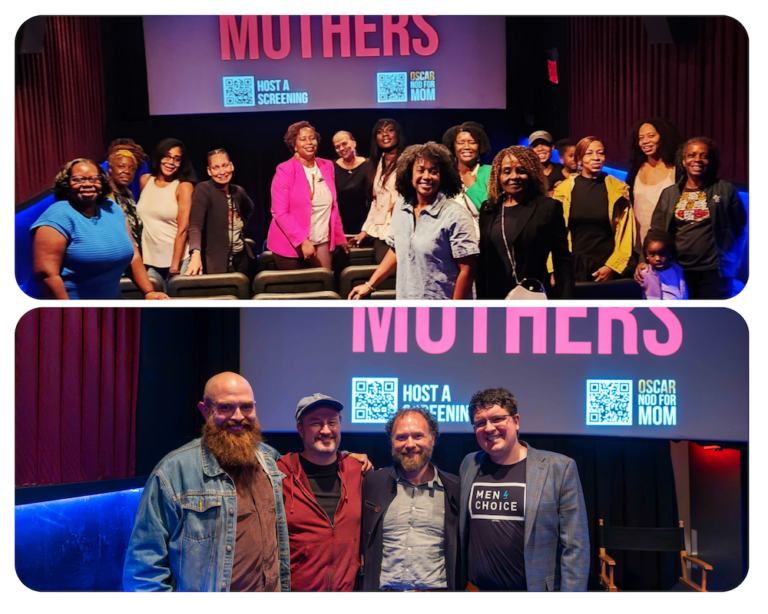
We’re grateful to Mocha Moms, NY (top) and Dads for All (bottom) for hosting screenings at Cinema Village
Thank You, New York!
To everyone who came out to Cinema Village to watch No Country for Mothers: thank you. Our theatrical run this past week wasn’t just a few movie nights, it was our shot at qualifying for the Oscars, and you showed up in a big way.
A special thank you to Mocha Moms, Inc., Unity in Color, Melly Belly, Dads for All, Peanut, Bobbie, Spread the Jelly, and Planned Parenthood Federation of America for collaborating with us on special free screenings for their communities.
Moms’ stories belong at the center of the stage in Hollywood. Help us get the Academy to recognize moms this awards season. Add your name to our petition by Oct 14.
No Country for Mothers: Screenings Happening Near You
Check for a local screening in your city or join a virtual watch party.
- Mancos, CO, Sept 25, 6:30-9 PM at Mancos Public Library — RSVP
- Virtual Watch Party (VA), Sept 25, 12-2 PM — RSVP
- Houston, TX, Sept 25, 11:15 AM-12:30 PM at St. Agnes Academy — RSVP
- Virtual Watch Party (CA), Sept 25, 10 AM-12 PM — RSVP
- Fort Worth, TX, Sept 25, 5-8 PM at United Way of Tarrant County — RSVP
- Philadelphia, PA, Sept 25, 6-8 PM at Restore Physical Therapy and Pelvic Health — RSVP
- Virtual Watch Party (NJ), Sept 25, 7-9 PM — RSVP
- Rockville Centre, NY, Sept 25, 7:30-9:30 PM at United Church of Rockville Centre — RSVP
- Virtual Watch Party (MA), Sept 26, 12-1:30 PM — RSVP
- Burbank, CA, Sept 27, 12-2 PM at Local 80 — RSVP
- Lyons, IL, Sept 27, 4-6:30 PM at Le Village Cowork — RSVP
- Phoenix, AZ, Sept 27, 6:30-8:30 PM at Alcove Wine, Beer & Provisions — RSVP
- Virtual Watch Party (NY), Sept 28, 12:30-2:30 PM — RSVP
- Virtual Watch Party (NY), Sept 29, 12:30-1:30 PM — RSVP
- Charlottesville, VA, Sept 30, 5:30-8:30 PM at Violet Crown Charlottesville — RSVP
- Baton Rouge, LA, Sept 30, 5:30-7:30 PM at The Red Shoes — RSVP
- Owensboro, KY, Sept 30, 5:45-7:45 PM at Western Kentucky University Owensboro Campus — RSVP
- Lake Forest, IL, Sept 30, 6-10 PM at Gorton Center — RSVP
- Troy, NY, Oct 1, 5-6:30 PM at Tiger Mama — RSVP
- Pittsburgh, PA, Oct 1, 5:30-7:30 PM at Carnegie Mellon University — RSVP
- Detroit, MI, Oct 1, 6-9 PM at Femology @ Newlab — RSVP
- Jersey City, NJ, Oct 1, 6-9 PM at DVORA — RSVP
Want to host your own? Head to our Host Hub for all the info you need to set up your event. Attend our upcoming virtual office hour on Oct 9 at noon ET, if you need some extra support with setting up your event
I don’t have all the right words for what I’ve been feeling either, but I’m done waiting for someone to hand them to me. Say what’s true for you out loud, this week, to someone who can actually help.
Weathering this storm with you,
