
The other night, after I finally got my sons to sleep and the house was quiet in that fragile way it only is after bedtime, I picked up my phone and started scrolling.
Within seconds, I realized I wasn’t just seeing posts — I was seeing a pattern.
First, there was a mom in her garage at 5:00 a.m., filming herself lifting weights before her baby woke up. The caption read, “No excuses.”
I scrolled and saw another reel promising to “snatch your waist in six weeks postpartum,” complete with before-and-after photos and triumphant music.
A few posts later, a different mom explained how she “got her body back” in 12 weeks, neatly arranged meal prep containers lined up behind her like proof of discipline.
And then came the phrase that always lands with a quiet sting: “We all have 24 hours in a day.”
None of these women were doing anything wrong. They were proud of their progress, and that pride is real. But taken together, post after post, transformation after transformation, the message becomes harder to ignore. It builds a quiet hierarchy where the mothers who shrink the fastest rise to the top.
And that’s when the questions creep in for many of us: Am I lazy? Am I not disciplined enough? Why does everyone else seem to be managing this better?
This is what “bounce-back culture” actually looks like. It’s ambient. It surrounds you until it feels normal that the ultimate postpartum achievement is returning to a smaller version of yourself as quickly as possible.
What gets lost in that expectation is something far more obvious and far more important: childbirth is a major medical event. Recovery isn’t cosmetic. It’s biological. And it takes time.
The Pressure Has Scaled
For years, the pressure to “get your body back” lived mostly in fitness programs, detox juices, and transformation reels. Now it has scaled.
GLP-1 medications — the same class of drugs as Ozempic and Wegovy — started becoming a household name in 2021 when the FDA approved Wegovy for weight loss. Now one in eight adults say that they are currently taking a GLP-1 drug either to lose weight or treat a chronic condition.
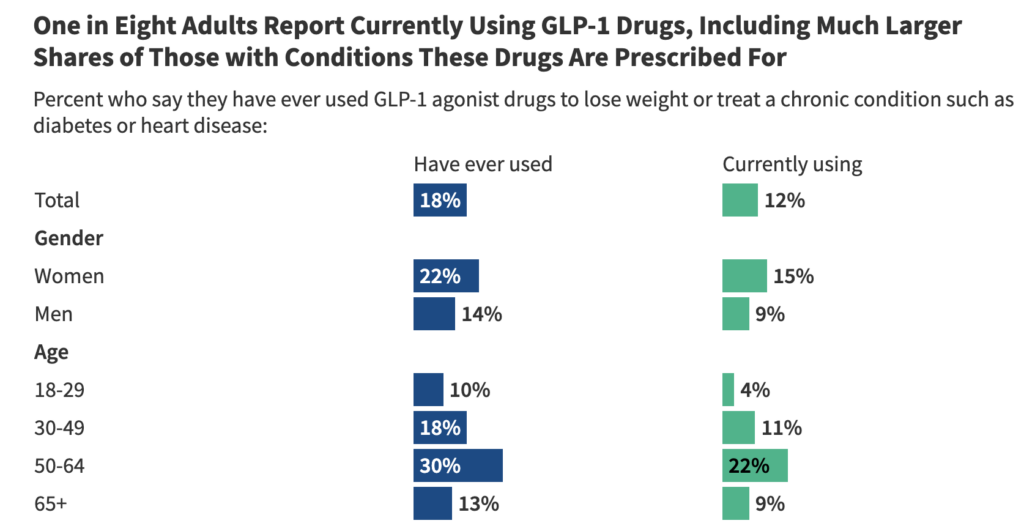
Source: KFF Health Tracking Poll
Pharmaceutical companies have been racing to expand the drugs from injections to pills and analysts project the global weight-loss drug market could exceed $100 billion annually in the coming years.
Recent reporting indicates prescriptions are also rising among postpartum women, with a new study showing that the GLP-1 drugs are prescribed for nearly two percent of new mothers. This adds another layer to the quiet message that your body is a problem to solve… and to solve quickly.
This isn’t about criticizing medication. For some people, these drugs are medically appropriate and transformative. It’s also not about criticizing women who find strength and confidence through fitness.
What this is about is pressure and the way our culture has become remarkably efficient at monetizing maternal depletion.
We don’t provide federal paid leave in this country. We don’t provide comprehensive postpartum care. But we are rapidly building a multibillion-dollar industry designed to help mothers get smaller.
That contrast should give us pause.
What Postpartum Recovery Actually Looks Like
Childbirth is not a cosmetic event. It is a full-body medical experience that can take months, sometimes years, to recover from.
Postpartum healing often includes abdominal muscle separation (diastasis recti), pelvic floor dysfunction, C-section wound healing, major hormonal shifts, and relentless sleep deprivation. Yet many women receive a single six-week postpartum checkup and are expected to navigate everything else on their own.

At the same time, about one in four new moms returns to work just two weeks after giving birth. Not because their bodies have healed, but because the system leaves them with little room to do otherwise.
Only a limited number of states offer paid leave, there is no guaranteed federal protection, and health insurance is often tied to employment, meaning the job they are racing back to is also what determines whether they can access the care they still need.
We demand aesthetic recovery before we provide structural recovery.
The System Is the Real Trap
This is where the lens has to widen.
When leave is short, healing is rushed. When postpartum care is minimal, new moms are left to navigate uncharted physical and emotional territory on their own, often delaying the support they need because they don’t even know what’s normal. When healthcare doesn’t cover full recovery, women absorb the cost themselves. And when systems fail mothers, culture tells them to fix what is visibly “wrong.”
The bounce-back narrative thrives in a country that refuses to invest in postpartum recovery but eagerly invests in postpartum weight loss.
Over time, that message gets internalized. We start to believe that if we just tried harder — woke up earlier, optimized more — we could overcome what are actually structural gaps in policy and care.
But mothers are not failing. They are navigating a system that withholds support and then critiques the visible evidence of that neglect.
If you are in the middle of postpartum recovery right now, please hear this clearly: your body is not a project. It is evidence of something extraordinary it just accomplished.
Healing is not a race and the real trap isn’t the weight. It’s the belief that mothers must prove their value by shrinking themselves at the exact moment they are stretched the thinnest.
We don’t need smaller mothers. We need larger safety nets, longer leave, deeper care, and systems strong enough to hold the weight mothers already carry.
Action Center
If you’re tired of being told to shrink when what you really need is support, here are a few ways to push back.
- Share this with a mom who needs to feel less alone. Sometimes the most powerful thing we can offer each other is the reminder that what we’re feeling isn’t a personal failure, it’s a shared experience.
- Tell your story. If you have a postpartum story, submit it through our Associate Producer campaign. The more honest we are about what motherhood actually looks like, the harder it becomes to sell us the fantasy.
- Know your rights. If you live in a state that offers paid leave but aren’t sure what you’re entitled to, check our PaidLeave.AI tool and get clear on your benefits.
- Push for change where you live. If your state doesn’t offer paid leave, make some noise. Use our simple form to write your representatives — it takes less than two minutes.
In Case You Missed It
A Moment for the Movement
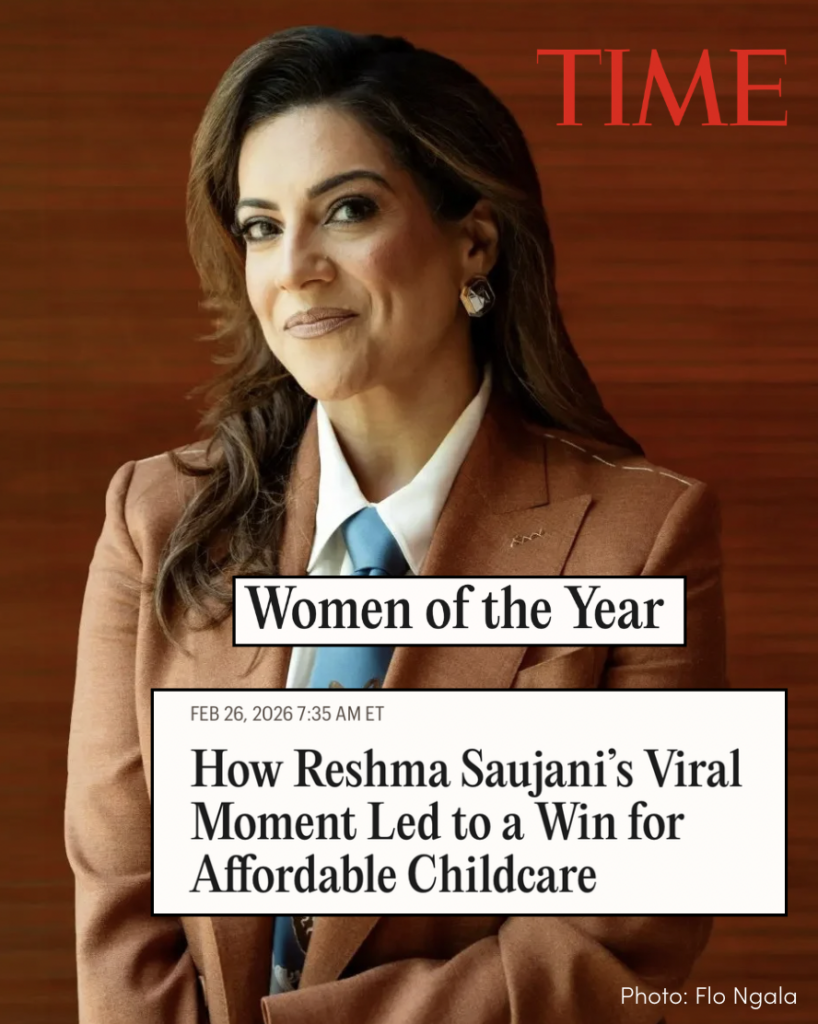
This week, I was named one of TIME’s Women of the Year, alongside 16 leaders working toward a more equitable world.
I am deeply honored, especially to be recognized among women whose courage and leadership I admire so much. At a time when it can feel risky to stand up for women, this acknowledgment means more than I can say.
For years, moms have been told that if we just tried harder — were more organized, more grateful, more resilient — we could make a system that doesn’t support us somehow work. We internalized the pressure. We blamed ourselves.
But the truth is that American motherhood is set up to make you fail. And that’s not accidental.
Through Moms First, we’ve been working to expose that truth — reframing unpaid caregiving as an economic issue, mobilizing moms and allies across the country, and pushing for real policy change. Together, we’ve helped move child care from a private burden to a public priority.
This recognition isn’t about me. It’s about the fact that the fight for moms can’t be ignored anymore.
The story of American motherhood is finally being told. And it belongs to all of us.
Mark Your Calendar

Join Our Upcoming Webinar: Moms, Elections & What’s at Stake
In just one week, we’re coming together for a powerful conversation about what’s happening to our elections and what it means for our families. And already, thousands of moms have signed up.
We’ll be joined by a powerful lineup of speakers to break down what’s real, what’s rhetoric, and what comes next for our elections and our democracy.
This isn’t just a webinar. It’s a chance to connect with other moms who care deeply about the future our kids are inheriting.
If you haven’t saved your spot yet, now’s the time. Don’t miss this one.
A Practical Playbook for Working Motherhood
This International Women’s Day, we’re proud to partner with Momcozy and WorkLife Law to launch the Working Motherhood Toolkit: Know Your Protections & Plan with Confidence — a free, trimester-by-trimester guide to help moms navigate maternity leave, pumping at work, child care planning, and the return-to-work transition with confidence.
Too often, women are handed a baby and a maze. This toolkit changes that. It breaks down state leave laws, explains workplace pumping protections under the PUMP Act, and helps moms prepare for those critical postpartum months while honoring that there’s no one-size-fits-all path.
Momcozy is also hosting a free, four-part webinar series, Working Motherhood: Balancing Caregiving, Career & Mental Load, featuring experts to tackle paid leave, pumping rights, burnout, and redefining ambition after baby.
Join Moms First for the first webinar, Know Your Rights: Paid Leave, Childcare & Pumping at Work, on March 2 at 1PM ET. Register today.
Because moms don’t just need celebration. They need real tools…and systems that actually work for them.
P.S. Momcozy is also offering 15% off sitewide with code WEBINARQ1, valid March 2-April 2, as part of its International Women’s Day promotion.
Making Headlines
Check out what people are saying about Moms First in the news:
- Child Care and the Economy (Think Tank with Steve Adubato)
- Work Friends Podcast Feat. Reshma Saujani (Argent)
Mothers don’t need smaller bodies — they need bigger protections, longer leave, and care that matches what they’ve given. It’s time to move the pressure off mothers’ bodies and onto the systems that were always supposed to support them.
Standing with every mom who’s tired of shrinking,
Reshma Saujani