
This time, there’s no pandemic to blame — just mothers losing ground while everyone else holds steady.
School drop-off is at 9. You’re expected at your office at 8:30.
Pickup is 3:30. Your meeting runs till 5.
Childcare costs more than college tuition.
Summer camp isn’t a vacation plan. It’s a second rent payment.
Return-to-office didn’t just take away your flexibility. It took away the precious time that let you get your kid — and yourself — to the doctor without burning a full PTO day on the commute alone.
This isn’t a bad week. This is the math millions of mothers run every single morning, alone, before anyone else in the house is even awake. And this year, economists finally gave that math a name: the mom-cession.
The Name and the Number
Since December 2023, research has shown that labor force participation among mothers with a bachelor’s degree or higher whose youngest child is under 5 has declined — even as it rose for women without kids, and for most men, including fathers of young children.
Sit with the irony of that for a second. These are the mothers with the most credentials. The most “employability,” by every metric that’s supposed to protect a worker in this economy. The degree didn’t protect them. A system with no room for the kid did them in instead. Heather Long, chief economist at Navy Federal Credit Union, put a name to it: the “mom-cession.” Naming a crisis doesn’t make it news to the people who’ve been living inside it.
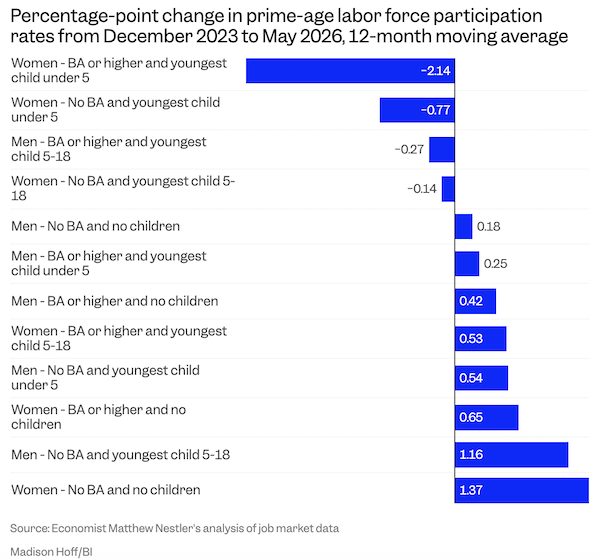
Source: Business Insider | July 2026
No Shock to Hide Behind
I want to be precise about what’s different this time, because it matters. In 2020, we called it the she-cession — a term coined by C. Nicole Mason, then president of the Institute for Women’s Policy Research. That recession had a villain everyone could see. A pandemic shut down the industries women dominate and the childcare system overnight. It was involuntary. It was a shock. Mason herself has since said what’s happening now is more deliberate than what she first named. This time, it isn’t an emergency forcing anyone’s hand. It’s workplaces and policies that simply refuse to evolve when nothing is making them.
Everyone is feeling the squeeze right now. Rent. Groceries. Gas. Childcare that costs more than housing in all 50 states, and in 38 states costs more than public college tuition. But there’s one group getting squeezed twice. While the labor market holds steady for women without kids and for fathers of young children, mothers of young children are the one group actually losing ground.
That’s not a coincidence. That’s a pattern. And patterns are choices, repeated.
What’s Actually Driving It
Just this morning, USA Today reported that over the past year, about 1 million workers have left the workforce. In June alone, 720,000 people exited. What is the cause of this mass exodus? As moms, we don’t need to have economics degrees to name the cause, because we’re living it everyday. It’s two forces, colliding: return-to-office mandates, and a childcare system that never got fixed after the pandemic exposed every crack in it.
Nearly half of young children in this country live in areas without enough licensed childcare to go around. Since mid-2024, daycare and preschool prices have climbed at roughly twice the pace of overall inflation.
At the same time, office mandates have tightened fast: by the second quarter of 2025, 54% of Fortune 100 employees were required back in the office full-time, up from just 5% two years earlier. The average number of required in-office days also climbed from 2.6 to 3.9 per week over that same stretch. That’s the collision in one sentence: less childcare to rely on, less flexibility to work around it. It’s no wonder labor force participation for women 25 to 44 with kids under 5 fell 2.8% in just the first half of 2025 — the steepest mid-year decline in four decades.
What Mothers Actually Want
Here’s what makes this so infuriating: mothers never asked for less. Nearly three in five parents who are out of work or working part-time say they’d work full-time if affordable, quality childcare actually existed. More than 455,000 women exited the workforce between January and August of last year, and the departures labeled “voluntary” were overwhelmingly driven by structural failure — lack of flexibility, childcare costs outpacing wages — not a lack of ambition, according to Catalyst’s research. This was never a story about mothers wanting less. It’s a story about a system that made “less” the only option left on the table.
Replaceable at Work, Not at Home
And here’s the part I can’t stop thinking about. Corporate America has told mothers, over and over, in every language it knows how to speak, that they are a line item. Layoffs by headcount. Roles quietly handed to AI. Loyalty that only ever runs one direction.
Meanwhile, these same mothers are watching their kids grow up in real time, and they’re noticing something else: there is exactly one place they are not replaceable. Their kid notices who’s in the audience at the school play. Their kid notices who’s the last pickup at the aftercare program. The dangerous part isn’t that mothers are seeing this clearly. It’s that the message is landing and they’re starting to agree with it. When a workplace spends years proving it doesn’t value you, don’t be surprised when someone finally stops arguing the point.
This isn’t a story about mothers opting out. It’s a story about mothers being pushed to a conclusion by a system that built the case against itself, one RTO email and one childcare bill at a time.
Where This Leaves Us
Naming a crisis is not the same as fixing one. Economists can hand this pattern a label. Only policy — paid leave, affordable childcare, workplaces actually built for the people doing the caregiving — can hand mothers their time back. Until then, it’s still 9am drop-off, 3:30 pickup, and the hamster wheel that never stops.
I see you running the math. I’ve run it myself. And I’m not interested in a world that keeps asking mothers to solve for a problem it refuses to fix.
That’s what we’re building at Moms First. Not another awareness campaign.
The actual fix.

Let’s do more than simply name the problem. Here’s two ways to turn what you just read into something bigger than a newsletter:
Tell Us Your Story
If today’s issue hit close to home — if you’ve left the workforce, or you’re standing at that edge right now, wondering if you can keep doing this — we want to hear it. We’re collecting these stories as part of the American Motherhood Tour, because the data only tells half of it. Your story is the other half.
Bring Your People Together
You don’t have to carry this alone, and you don’t have to say it quietly. Moms across the country are gathering in living rooms, libraries, and break rooms to screen No Country for Mothers and have the real conversation afterward — the one about what actually needs to change.Say what you have to say, with your full chest. Host a screening (or attend one of the 300+ screenings happening nationwide).

Screenings Happening Near You
New community screenings and watch parties for No Country for Mothers are popping up everyday. Attend one of the 300+ that are on the schedule or host your own:
- Phoenix, AZ July 15, 6:30-9 PM at Alcove Wine, Beer & Provisions — RSVP
- Salt Lake City, UT July 16, 1-4 PM at Marmalade Branch SLC Public Library — RSVP
- Needham, MA, July 16, 6-8:30 PM at Needham Public Library — RSVP
- Chicago, IL , July 16, 6-9 PM at Fabrik Chicago — RSVP
- Denver, CO July 16, 5-7 PM at Harvey Park Recreation Center — RSVP
- Vero Beach, FL July 17, 5-8 PM at East Coast Boba Company — RSVP
- West Tisbury, MA July 17, 5:30-9:30 PM at Able Moraine Interior Studio— RSVP
- Carson City, NV July 17, 7-9 PM — RSVP

Check out what people are saying about Moms First in the news:
Every mother running this math deserves better than a headline. She deserves a country that actually shows up. That’s what we’re here to build and we’re so grateful you’re a part of this movement with us.
With gratitude,
