
Biology didn’t assign you that 3am feeding. Society did.
I was catching up with a friend recently — one who had gotten divorced years ago. She was reflecting on those early years of motherhood, back when she was still with her then-husband and her kids were newborns. The exhaustion. The brain fog. The 3am feedings that were always, without question, hers. Every time a baby stirred, every time someone cried out in the night — she was the one who got up. Because her then-husband had made one thing very clear: babies need their mothers. Women are wired for nurturing in a way that men simply aren’t.
She believed him. For years, she believed him.
I’m here to tell you: that’s not biology. That’s a story (and more like one of weaponized incompetence, if you ask me). One that was told to us so many times, by so many people, in so many forms that we stopped questioning it. We internalized it. We made it ours.
But the science? The science tells a very different story.
“You’re Just Wired That Way”
We’ve all heard it. Women are natural nurturers. Men are natural providers. It’s in our DNA. It’s hormonal. It’s just the way things are.
This mythology shows up everywhere. It shows up in who wakes up when the baby cries. In who’s automatically listed as the emergency contact at school. In who knows the names of every teacher, every pediatrician, every medication and dosage. In who is assumed to just know and who gets a gold star for showing up.
To be clear: there are real biological differences in the postpartum period. Breastfeeding is real. The hormonal shifts of pregnancy and birth are real. I’m not here to pretend otherwise.
But there is a hard line between “some biological differences exist” and “therefore men are off the hook.” We have been using the first sentence to justify the second for generations. And it was never true.
This isn’t about biology. It’s about who gets permission to show up.
The Receipts
Let’s talk about what the science actually says. Because researchers have been studying this for decades and the data is unambiguous.
On oxytocin — the so-called “bonding hormone.”
Researcher Ruth Feldman at Bar-Ilan University tracked oxytocin levels in 80 first-time parent couples. Fathers who actively engaged in caregiving showed oxytocin levels that matched those of mothers — even without the hormonal triggers of pregnancy, birth, or breastfeeding. The hormone doesn’t respond to gender. It responds to behavior.
On the “caregiving brain.”
A landmark 2014 study published in PNAS used fMRI to study the brains of mothers, fathers, and primary-caregiving fathers. The finding? A global parental caregiving neural network that was largely consistent across all parents. When fathers took on the primary caregiving role, their brains, including the amygdala and emotional processing centers, activated in ways comparable to mothers.
Feldman put it plainly: “Fathers have the capacity to do it as well as mothers, but they need daily caregiving activities to ignite that mothering network.” The brain adapts to the role. Not to the gender.
On testosterone.
A Northwestern University study published in PNAS found that new fathers showed a 26% drop in morning testosterone and a 34% drop in evening levels compared to non-fathers. What’s more, testosterone levels were lowest in the men who spent the most time with their children. A separate 2025 longitudinal study found that lower testosterone in expecting fathers predicted greater postnatal caregiving involvement.
And before anyone clutches their pearls about dropping T levels — that’s not weakness. That’s an adaptation. The same way a mother’s body transforms for parenthood, so does a father’s. It’s proof that the male body doesn’t resist caregiving. It actually prepares for it.
On competence. Research consistently shows that fathers perform just as capably as mothers on infant care tasks when equally trained and equally expected to perform them. The competence gap is not innate. It is manufactured by low expectations, by a culture that applauds fathers for “helping” and treats mothers’ labor as invisible.
The gap is in assignment, not ability.
Follow the Incentive
So, if science doesn’t support the “wiring” myth, where did it come from?
Follow the incentive.
The breadwinner/caregiver split that so many of us were raised to see as natural is, in fact, an industrial-era construction. It was built to serve an economy that needed women’s unpaid labor at home and it has been remarkably resistant to disruption ever since.
Weaponized incompetence is the myth’s most effective tool. When a man says “I don’t know how to do that” regarding how to soothe the baby, how to schedule the appointment, how to pack the lunch — the work doesn’t disappear. It defaults back to the woman who “naturally” knows how. The 3am negotiation was never about wiring. It was about who had more to lose by being incompetent.
The numbers bear this out. Among full-time working parents, mothers still perform 1.6 times as much childcare and household labor as fathers. That’s 19.5 hours per week compared to 12.3.
Weekly Hours Spent on Childcare and Household Work by Gender and Race/Ethnicity
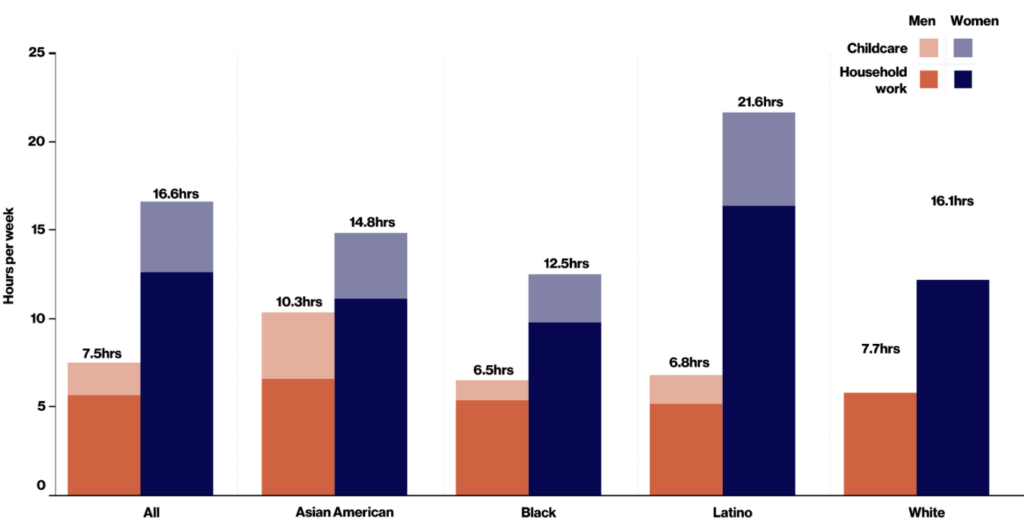
Source: Gender Equity Policy Institute Analysis of ATUS 2022
The 3am Shift Isn’t Instinct. It’s an Assignment.
I keep thinking about my friend. About all the nights she got up so her husband could sleep. About the story he told her and that she carried it, alone, for years.
What I want to say to her — what I want to say to every woman who has heard some version of this myth — is this: It was never about your wiring. It was about who got to opt out.
If you’ve heard this myth at home, at work, in a pediatrician’s waiting room, in the silence of a 3am rocking that was always yours — you now have the receipts. The science is unambiguous. Men are not less capable of nurturing. They have simply been less required to it.
The work of dismantling this lie is generational. It lives in our policies, our workplaces, our relationships, and the quiet negotiations that happen in the dark. But it starts, as it always does, with calling it out when we see it.

New Host Resources
Hosting a screening of No Country for Mothers? We’ve got everything you need: movie poster, trailers, social media graphics, press kit, conversation starters, and even a bingo card to make your event one to remember. Head to our Host Resources page and let’s bring this movement to your community.
And, check out the official American Motherhood Tour Merch Store to pick up limited-edition items for yourself and your guests.

Watch the Film on June 17
Our virtual national watch party for No Country for Mothers is next Wednesday at 7 PM ET and we’d love for you to join us.
Gather with mothers and allies from across the country for a special evening as we watch the film in its entirety, fire up the group chat, and kick off the American Motherhood Tour together.

Last Chance to Qualify for Gloria’s.
If you’re hosting a No Country for Mothers screening with 10+ RSVPs, today is your final day to be eligible for our Gloria Steinem Talking Circle on July 9 in NYC. Five hosts. One living room. Submit your interest form today.

Check out what people are saying about Moms First in the news:
- Childcare gaps fuel burnout for working parents, survey finds (Employee Benefit News)
- How these female founders found room in their budgets for childcare (HR Brew)
- Two Drinks with . . . the Mom Who Prodded Trump About Childcare (The Free Press)
- It’s not your imagination, parenting is getting harder. Here’s why (USA Today)
We have always known that the “wiring” argument was never really about biology. It was about permission. Who gets it, and who gets burdened when it’s never granted. The science has given us the receipts. Now it’s our job to stop accepting the lie.
Calling out the cons,
