
Single mothers are the fastest-growing family structure in America, but we’ve built every system — workplaces, tax code, childcare, housing — as if they don’t exist.
Let me tell you about someone I think about a lot.
She brings home the bacon. She fries it up. She sets the table. She does the dishes after everyone else has gone to sleep.
Alarm at 5 am. Lunches packed by 6:30. Drop-off, then a full day of work, then pickup, then dinner, then homework, then bath, then bed. Hers is the only pillow no one fluffs.
This isn’t a hard week. It’s a sprint nested inside a marathon, every single day for a single mom. And when she crosses the day’s finish line, there’s no medal and no rest. Just the starting gun for tomorrow. No one to tag in. No one to notice she’s running on empty.
Here’s the thing nobody says out loud: none of this is an accident. Every system a family leans on — workplaces, tax code, childcare, housing — was built around a specific picture of who a family “should” be in the US: white, heterosexual, two married parents, one breadwinner. She was never an oversight. She was the household those systems weren’t designed to include in the first place, and no one’s gone back to redesign them since.
So let’s talk about who she actually is. Because it’s not who you think.
Who She Actually Is
Stop with the tropes. There is no profile of a single mother (and the data backs me up):
- 40% of babies born today are born to unmarried women. That doesn’t mean single or unpartnered — plenty of those mothers are cohabiting with a partner. But it does mean the married, two-parent household our systems still assume is no longer the default.
- 70% of single mothers are 30 or older. Most aren’t young women who “got themselves in trouble” — they’re adults navigating divorce, widowhood, or a deliberate choice to raise a child on their own terms.
- 75% of single mothers are employed — a higher labor force participation rate than married mothers. The old story that single mothers don’t work has never been true. The real story is one income doing the job two used to share.
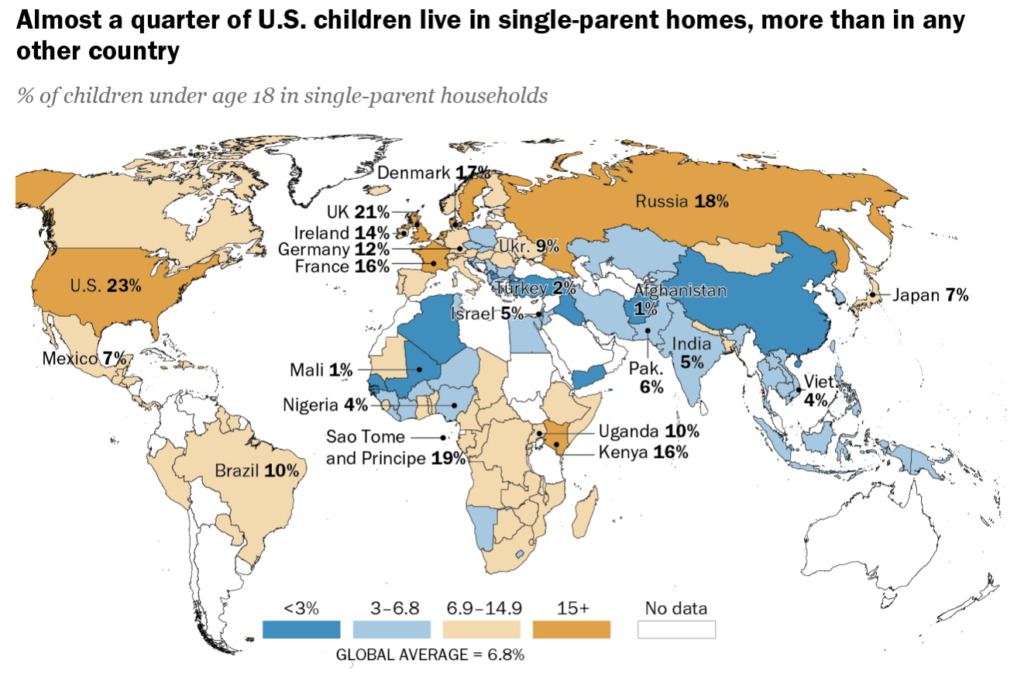
- The U.S. has more of her than any peer nation. Nearly a quarter of American kids live with one parent and no other adult in the house, more than three times the global average.
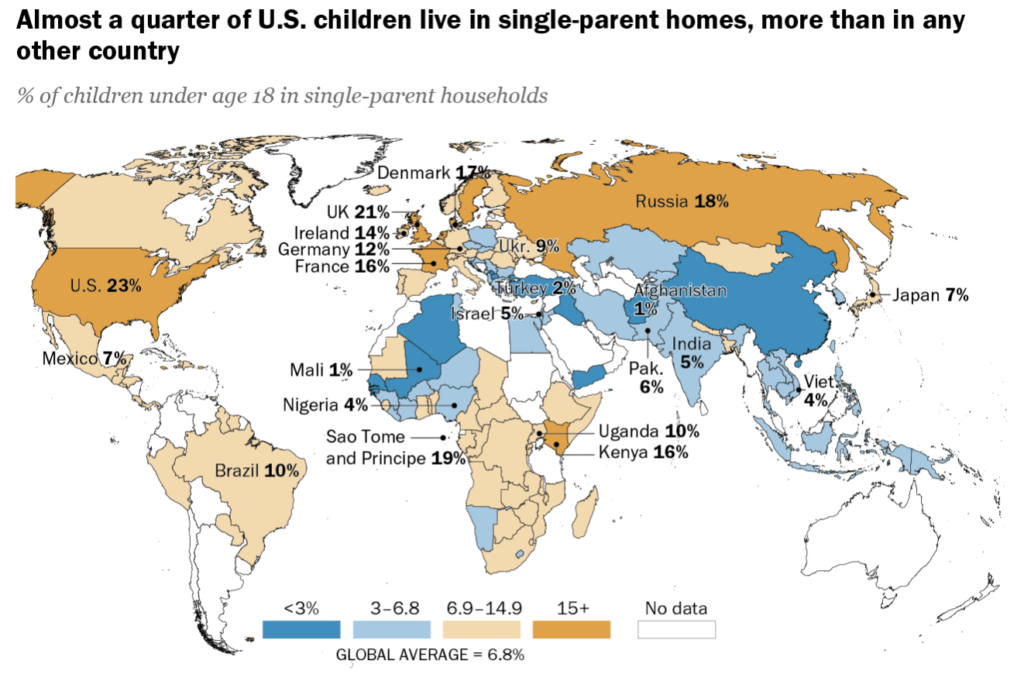
Source: Pew Research
Keep in mind that capable is not the same as fine. Single mothers are nearly three times as likely as married mothers to experience severe psychological distress. 43.5% get fewer than seven hours of sleep a night, compared to 31.2% of mothers in two-parent homes. There’s no one to take the early shift.
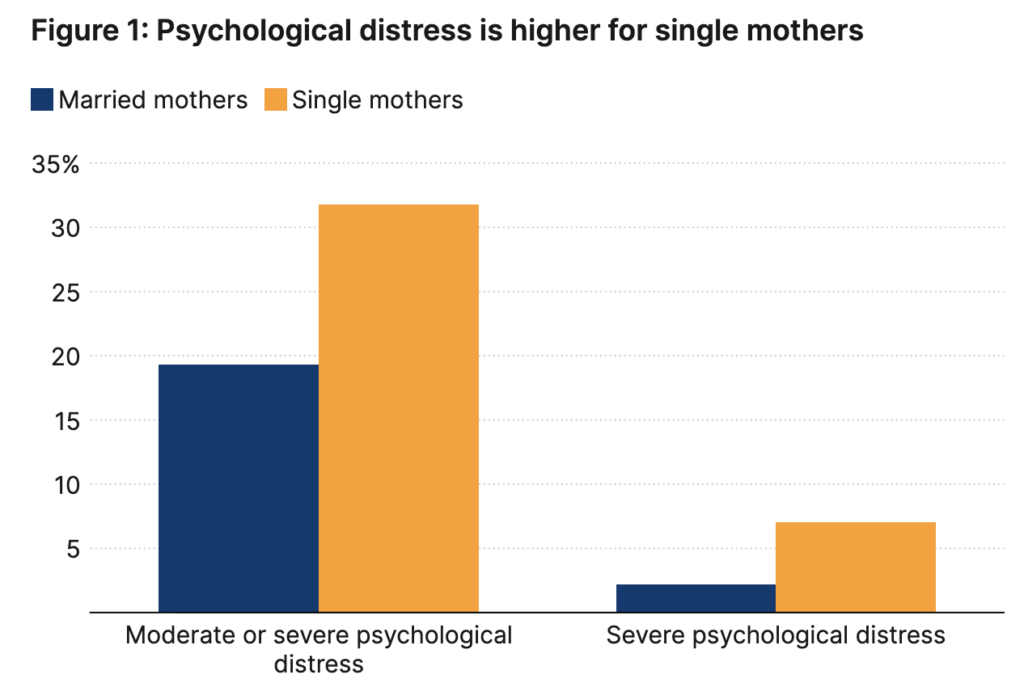
Source: Brookings
In Her Own Words
You don’t have to take my word for any of this, because she told us herself.
Jeremiah Program is a national nonprofit that works to disrupt generational poverty for single mothers and their children. Part of what they do is research and storytelling that puts single mothers’ own accounts on the record.
Jeremiah and the Urban Institute recently surveyed nearly 1,800 single mothers across 43 states about their own year. Here’s what they said:
- 97% experienced housing hardship.
- 85% reported food insecurity, including 53% who regularly skipped meals or went without food.
- 72% struggled to pay medical bills.
- 64% had to quit a job, turn down work, or change their employment because of childcare — rising to 76% among student parents.
Jeremiah Program’s President and CEO, Chastity Lord, put it about as plainly as it can be put: single mothers aren’t a monolith. They’re workers, students, caregivers, and leaders doing everything right in a system that was never built with them in mind.
The Village Is Gone
The village didn’t disappear by accident. Extended family scattered. Neighbors stopped knowing each other. The informal webs of support that used to catch people, quietly, before anyone had to ask…all of that frayed. For a single mother, that’s not an inconvenience. It’s a structural emergency.
What isolation and being the sole provider actually produce, day after day, is a specific kind of exhaustion.
One single mom told our team that after she puts her son to bed every night, she has to choose between a shower, sleep, or thirty minutes of “me time” because she can’t have all three. And, that’s not just one bad night. That’s the ceiling of what rest looks like when there’s no one else in the house to hand anything to.
Built for Someone Else
I’ve said for years that if you want to know whether a workplace policy is any good, don’t test it against the average worker. Test it against the parent with no backup — no partner to leave early instead of her, no family down the street, no second income to absorb a bad month. Build for her and you end up helping every parent, married or not. Build for the “traditional” family instead, and she’s the one who falls through. Every time.
Corporate America did the opposite, and it’s still pissing me off.
Remote work was never a perk for single mothers; it was the architecture of survival, the thing that made it possible to pick up a sick child at 2 pm and finish the work at 9. Then it got taken away.
Labor force participation for mothers with young children dropped nearly three percentage points in the first half of 2025 alone, as full-time office mandates nearly doubled across Fortune 500 companies.
For a single mother, a five-day return-to-office mandate isn’t a culture initiative. It’s a termination notice dressed in corporate language.
What This Costs
And here’s what the failure costs in dollars, because it always comes back to dollars. Center-based infant care now runs more than 35% of a single mother’s median income.
It’s already getting worse, too. Since the 2025 reconciliation law took effect, states have faced a new cost shift for SNAP. Rather than absorb it, most are choosing to restrict who qualifies and shrinking caseloads instead of covering the cost themselves. Cuts to Medicaid eligibility are following the same pattern. The crisis Jeremiah Program’s data captured this summer is poised to deepen, not ease.
What It Would Look Like If We Meant It
Here’s what it would look like if we actually built systems for her: affordable childcare, paid parental leave, flexible work that isn’t revoked the moment the market shifts, expanded child tax credits, and the literal village rebuilt as a policy priority instead of an afterthought.
If we actually valued families (and actually cared about the birth rate everyone claims to worry about) we’d support families the way mothers are actually having them: increasingly, as single mothers.

Reading this and feeling it isn’t enough. Whether you’re a single mother in the thick of it or you want to better understand how to show up for the single mothers in your community, here’s what you can do next:
- Explore Jeremiah Program. They’re the ones who put real numbers and real voices behind everything you just read. Give toward housing, coaching, and childcare for single moms working toward a degree. Mentor a mom if your time is what you’ve got to offer. Read the full report representing nearly 1,800 single mothers, in their own words. And if you’re a single mom yourself, see if becoming a JP Mom is your next step.
- Tell us your story. We built this issue on one mother’s words, and we want to hear more. If you’re a single mom — or one has impacted your life — share your story with us. We’re collecting them for a reason: the data proves the scale, but genuine, real stories are what moves people.

Childcare Just Got Bipartisan Attention in D.C.
Last week, Moms First’s National Business Coalition for Child Care, First Five Years Fund, and Etsy convened a dozen-plus corporate leaders with lawmakers from both parties to talk childcare. The catalyst: our Foundational Workers Report, which found solving the childcare crisis could unlock $70 billion in workforce output.
Lawmakers on both sides of the aisle are advancing solutions, including the bipartisan, bicameral Child Care Modernization Act, After Hours Care Act, and Expanding Care in Rural America Act.
Read the report and share it with your HR team.
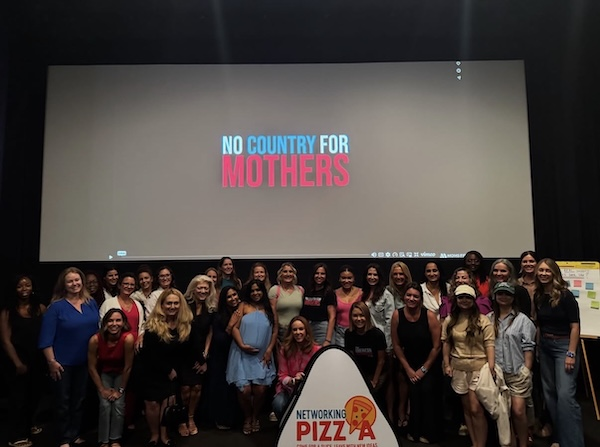
Screening in Orlando, Florida Hosted by Networking Pizza
No Country for Mothers: Screenings Happening Near You
More than 500 watch parties have been scheduled by moms and supporters in nearly every state. Check out some of the upcoming screenings happening soon.
- Granite Bay, CA, Aug 2, 2-4 PM — RSVP
- Bloomfield Township, MI, Aug 5, 6-8 PM at Bloomfield Township Library — RSVP
- Virtual Screening (Queens, NY), Aug 5, 6:30-8 PM — RSVP
- Riverside, IL, Aug 5, 6:30-9 PM at The Treehouse — RSVP
- Lexington, MA, Aug 5, 7:30-9:30 PM at Lexington Venue — RSVP
- Virtual Screening (The Woodlands TX), Aug 6, 9:30-11:30 AM — RSVP
- Denver, CO, Aug 6, 5-7:30 PM at Kim Robards Dance & KRD Venue — RSVP
- Columbus, OH, Aug 6, 7-8:30 PM at Studio 35 Cinema & Drafthouse — RSVP
- Virtual Screening (Los Alamos, NM), Aug 7, 5-7 PM — RSVP
- Canton Township, MI, Aug 7, 8-10 PM at Emagine Theater (Canton) — RSVP
- Chesterfield, MO, Aug 8, 5:30-8:30 PM — RSVP
- Chicago, IL, Aug 9, 2-4 PM at Independence Branch, Chicago Public Library — RSVP
Looking for a virtual event? Go to the events page and filter results by “Show virtual events only.”
Want to host your own? Head to our Host Hub for all the info you need to set up your event.

Check out what people are saying about Moms First in the news
- Documentary explores why U.S. mothers lack support systems found in other countries (PBS News Hour)
- Where to Watch ‘No Country for Mothers’? Complete Streaming Guide (Netflix Junkie)
- Badger Joins Business Leaders and Members of Congress in Washington, DC to Advocate for Childcare Access (EIN Presswire)
Our systems will keep failing families as long as we keep designing them for a household that stopped being the default decades ago. Single moms are proof of what it looks like when we build for who’s actually here instead. That’s the work and it’s worth doing.
For every mother doing it alone,
