
We Keep Selling Moms Relief Instead of Support
If you have a school-age kid, like me, you’re probably hanging on for your life right now.
May is supposed to be the home stretch before summer slows the pace of parenting. But for moms, it’s become its own version of December: a perfect storm of spirit weeks, field days, end-of-year performances, teacher appreciation gifts, permission slips, sports banquets, class parties, and awards ceremonies, all stacked on top of each other like some kind of endurance test no one signed up for.
There’s even a word for it now: Maycember. And it’s trending because moms everywhere are feeling the same thing at the same time — the calendar is exploding, expectations are at their peak, and somehow we’re supposed to hold it all together and smile through every single moment of it.
This is also Mental Health Awareness Month. The timing feels almost pointed.
Because the reality is that moms aren’t just tired right now. According to a 2025 study published in JAMA, the percentage of mothers who reported “excellent” mental health dropped from 38% in 2016 to just 26% in 2023 — a decline that cut across every socioeconomic background. And a national survey found that 57% self-reported burnout. More than half.
So I want to talk about what moms are actually doing to get through it.
Because it’s not yoga. And it’s not journaling. And honestly? I don’t blame them for a single second.
The Friends I Know
Let me tell you about some women I know.
There’s the mom who starts looking forward to her glass of Sauvignon Blanc around 3pm. Making dinner with a pour in hand has become a ritual, the one moment in the day that feels like it belongs to her. After the homework battles and the snack requests and the emails she still has to reply to, that glass of wine is the signal her nervous system has been waiting for all day: You made it.
Then there’s the mom who isn’t really a drinker. But after the kids are finally down, the lunches are packed, and the kitchen is clean, she bites off half a gummy and exhales for the first time since she woke up.
And then there’s the mom chugging a can of Celsius on the commute home from work, because she’s about to clock into her second shift. Dinner, baths, bedtime, and whatever the school app has decided to notify her about at 8:47pm.
These women are not outliers; the data makes that very clear. They are your colleague, your neighbor, maybe you even see a bit of yourself in them.
The Numbers Behind the Coping
Women aren’t reaching for these things in a vacuum. The market for mom-targeted relief has exploded because the need is real and the industry knows it.
On alcohol: a national survey found that women reported 41% more heavy drinking episodes in 2020 compared to 2019, a spike that outlasted the pandemic and reflected a trend that had been building for years. Research published through multiple peer-reviewed studies has documented how “wine mom” culture, which took off as a social media phenomenon in the early 2010s, doesn’t just reflect how stressed mothers are, it actively normalizes alcohol as the go-to coping mechanism for the weight of modern motherhood.
On cannabis and CBD: women make up 59% of all CBD users, and edibles — gummies, chocolates, beverages — are most popular among adults aged 35 to 49. That is, squarely, the mom demographic. Adult-use cannabis edibles represent a market now valued in the billions, with sales growing steadily year over year.
There’s an entire tired-mom industrial complex looking to make a buck off of us. “Mom Juice” wine is a trademarked brand. CBD wellness lines are specifically positioned around words like “calm,” “balance,” and “restore.” Energy drinks are marketed to women powering through their “second shift.” Corporations have studied maternal exhaustion carefully, and they have built entire product categories to sell it back to us.
This Is Not a New Story
Here’s the part that should make all of us stop for a second.
We have been here before.
In the 1950s and 1960s, Valium was prescribed to American women at twice the rate of men. Drug companies didn’t market Valium to treat illness. They marketed it to treat the experience of being a woman inside a system that had no room for her discontent. The ads were shameless: a mother overwhelmed by domestic life, smiling again, thanks to a little yellow pill.

1967 advertisement for benzodiazepine, Serax
The Rolling Stones wrote Mother’s Little Helper about it in 1966. Betty Friedan called the underlying condition “the problem that has no name” in The Feminine Mystique in 1963. Millions of women were chemically patched into functionality because nobody was asking the harder question: Why are these women so desperate to feel differently?
The answer then was the same as it is now. The system wasn’t built for them. And rather than fix the system, someone found a way to profit from the gap.
The substances have evolved from benzos to Bordeaux to broad-spectrum CBD. The marketing has gotten subtler and savvier. But the playbook is completely unchanged: when the structure fails mothers, sell them something to feel less.
The Gummy Isn’t the Problem. The Gap Is.
I want to be clear about something: this is not a judgment of any mom reaching for relief wherever she can find it. Moms are rational people. When you are running on empty, you reach for whatever refills you, even temporarily. We are all just trying to survive inside a system that is asking way too much.
But here’s what no CBD gummy, glass of wine, or energy drink actually gives you: Paid leave when your child is sick and you can’t send them to school. Affordable childcare that doesn’t cost more than a mortgage payment. A workplace that doesn’t penalize you for being a parent. A partner who carries equal mental load at home. A society that counts the second shift as the labor that it is.
The substances are a symptom. The disease is a country that has decided mothers should be able to handle everything, and when they can’t, the answer is a product, not a policy.
Real mental health support for moms doesn’t look like awareness ribbons in May and silence the other eleven months. It looks like healthcare that extends postpartum support beyond a six-week checkup. It looks like workplaces that stop treating motherhood as a liability.
We’re Not Done Fighting
May is Mental Health Awareness Month. And I think true mental health awareness, when it comes to mothers, means being honest about what we’re asking women to absorb in this country. It means naming the structural failures behind the coping. It means refusing to let the conversation stop at “self-care” when what moms need is systemic care.
The mothers in this movement know that. Every mom who has ever taken a breath at the end of a Maycember day and thought: It should not be this hard.
You are not the problem. You never were.
Moms don’t need another product. They need a country that finally shows up for them. The answer was never in the bottle or the gummy — it’s in the paid leave, the affordable childcare, the flexible workplaces, and the policies we’re fighting for every single day.
This movement exists because moms deserve more than something to take the edge off. You have been surviving on borrowed relief for long enough. It’s time we’re rewarded with something real.
In Case You Missed It

Watch the Film With Us
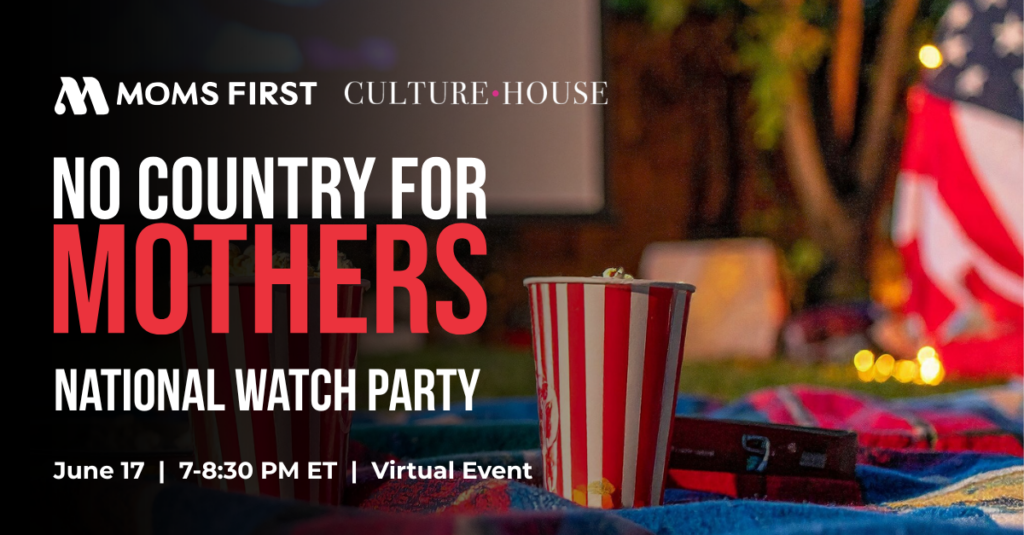
On June 17, at 7 PM ET, we’re gathering virtually with moms, caregivers, and allies from across the country for a special national watch party of No Country for Mothers — our new documentary exploring the culture wars surrounding American motherhood and the growing movement fighting for the support families deserve.
More than a film screening, this is a chance to come together for an evening of connection, conversation, and community as we officially kick off the American Motherhood Tour.
Whether you’re watching from your couch, hosting friends in your living room, or tuning in with fellow moms in your community, we hope you’ll be part of this moment.
This One’s for the Class of 2026. And Honestly, All of Us.
Last week, I delivered the commencement address at Franklin W. Olin College of Engineering, but my message wasn’t just for new graduates. In a moment when DEI is being dismantled, rights are being rolled back, and five billionaires seem to be calling the shots on everything, I had one charge for the class of 2026: we need your bravery more than we need your brilliance. Read or listen to the full speech on my Substack.
Free Fitness Classes for NYC Moms (And They’re Paying You to Show Up)
Columbia University is running a 12-week wellness study for moms that includes free weekly fitness classes, possible childcare and grocery delivery, and up to $150 in gift cards just for participating. Open to NYC moms 18+ with kids between 18 months and 12 years old. If you’re interested, complete the survey to see if you qualify.
Moms have been handed products when they deserved policies, and coping mechanisms when they deserved change. We deserve a country where motherhood doesn’t require something to take the edge off and I’m going to keep fighting until we build it.
If you’re hosting a screening of No Country for Mothers this year, you already know what I’m talking about. This film is about exactly this: the lies sold to mothers instead of the support they deserve. Find a screening near you or host your own.
Time for real relief,
Reshma Saujani