
Every few months, we’re served the same headline, dressed up like it’s breaking news: Women are leaving the workforce.
It’s usually framed as a mystery. Or a vibe shift. Or a lifestyle choice.
Let me be very clear: there is nothing mysterious about this.
Women aren’t leaving work.
Work is leaving women.
Over the past year, women’s participation in the labor force has slowed — sharply. In 2025, men joined the labor force at nearly three times the rate of women. In December 2025 alone, women accounted for 100% of labor force losses. And for Black women — who already face higher unemployment rates, lower wages, and fewer safety nets — the drop-off has been even steeper.
That doesn’t happen by accident. It happens when the system tightens, and women are still expected to absorb the hit.
This isn’t a one-month blip. It’s the predictable result of years of choices — by policymakers and employers — that have made motherhood harder, more expensive, and more fragile than it’s ever been.
So let’s stop pretending this is confusing and name what’s actually going on.
What’s Really Pushing Women Out of Work
First: child care is out of reach — financially and practically.
For millions of families, the math simply doesn’t work. Child care now costs more than rent in many cities. More than a mortgage. More than in-state college tuition. When care costs exceed take-home pay, someone has to step back, and in this country, that “someone” is still overwhelmingly the mother.
And even when families can afford it, many can’t find it. Providers are closing. Waitlists stretch for months or years. “Child care deserts” aren’t a metaphor — they’re entire zip codes with no options at all. But what about that village people love to talk about? For most parents, it doesn’t exist anymore.
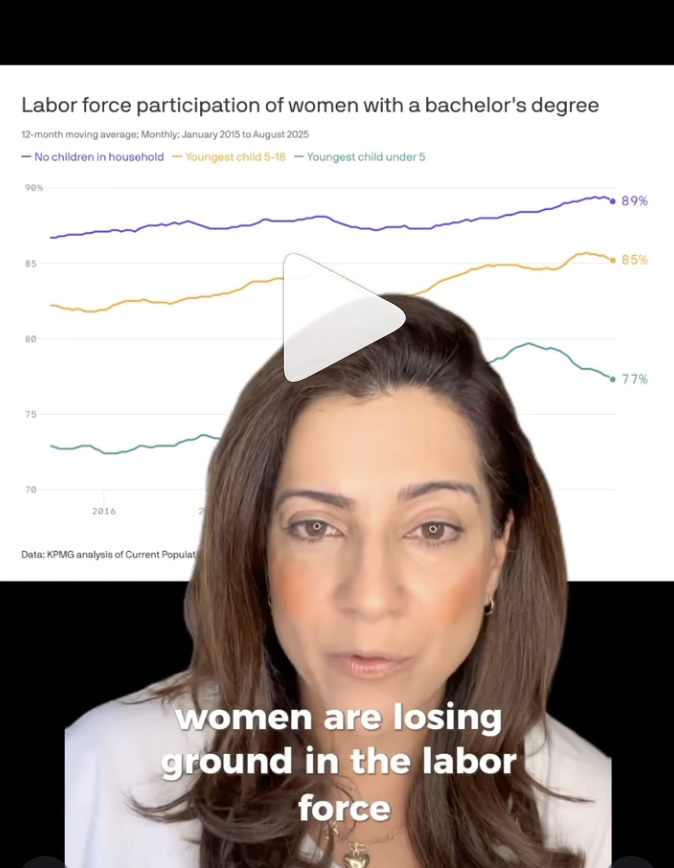
This isn’t about preferences or priorities. It’s about arithmetic. When child care collapses, women’s participation collapses with it. And for women of color — who have less financial margin to begin with — there’s even less room for error.
Second: workplace rollbacks are quietly doing what no layoff announcement ever could.
Return-to-office mandates are being sold as a return to “normal.” But for parents, they function like a hidden pay cut. More commuting costs. Longer child care hours. More time spent away from home. All with zero increase in pay and a whole lot less flexibility.
At the same time, companies are walking back DEI programs and worker protections — the very policies that helped women stay, advance, and feel safe at work.
Put those two forces together, and the outcome is entirely predictable: women don’t “opt out.” They get priced out. Pushed out. Squeezed out.
The Human Cost and the Proof That This Isn’t Inevitable
You can see the fallout everywhere.
In stories from new mothers describing what it’s actually like to return to work: pumping in closets, scrambling for care that doesn’t align with rigid workdays, pretending nothing has changed when everything has.
We see it in reporting on pregnant workers laid off with little notice, losing jobs and health coverage at the exact moment their families need stability most.
And in the data — month after month — showing that when the system tightens, women are still the shock absorbers.
But here’s the part that never makes the headline: we’ve already seen what works.
During COVID, when child care support expanded, families received direct relief, and flexibility increased, women came back into the workforce in record numbers. When those supports expired and flexibility was rolled back, women’s participation stalled again.
That’s not a coincidence. That’s cause and effect.
The Cost of a System That Refuses to Change
When women are forced out of the workforce, it’s not because they lost their ambition.
It’s because the system made it impossible to stay.
This isn’t a personal failure.
It’s a policy failure.
And it’s an economic one.
Child care isn’t a “nice to have.” It’s infrastructure. Paid leave isn’t a perk — it’s what keeps women attached to work. Flexibility isn’t a concession — it’s how families actually function.
And anyone who’s parenting right now knows this in their bones. The drop-offs that feel like a relay race. The Tetris game of summer camps. The 3 a.m. cluster-feeding sessions while your kid with Flu A coughs directly into your face. If you’re setting policy or running a company without understanding that reality, you’re not neutral — you’re out of touch.
When we invest in care, the economy responds. When we ignore it, we lose talent, productivity, and women’s trust — over and over again.
At Moms First, we’re organizing for a future where women don’t have to perform miracles just to stay employed. Where care is treated like the economic infrastructure it is. And where motherhood isn’t a liability you’re expected to quietly manage alone.
Because women aren’t leaving work.
Work is leaving women.
And it doesn’t have to be this way.
Action Center
Tell Us Your Story
If you’ve felt pushed out of work — by child care costs, return-to-office mandates, or lack of flexibility — we want to hear from you. Your experience helps show this isn’t about personal choice. It’s about systemic failure.
By sharing your story, like Tia did below, you can also become an Associate Producer of our motherhood documentary and join the parents working to change how this country treats women, work, and care.

In Case You Missed It
Big news from San Francisco: the city is making a major investment in child care as the linchpin of affordability.
Under Mayor Daniel Lurie’s new plan:
- Families earning up to ~$230,000/year will qualify for free child care
- Families earning up to ~$310,000/year will receive a 50% subsidy
These changes begin rolling out now, with further expansion this fall.
This policy is vital at a time when child care is one of the biggest drivers pushing families—especially moms—out of the workforce. We know that child care is affordable, families stay. Businesses retain talent. Cities thrive.
Some exciting things about San Francisco’s announcement: it includes expansion of infant and toddler care for kids 0-2, the most expensive segment of kids to cover but a vital one for working parents. And it includes significant investments in the early educator workforce, ensuring child care workers can earn a living wage.
At Moms First, we’ve been proud to have discussions with the Mayor’s team as they developed this approach and are excited to partner to encourage California to make even deeper child care investments. It’s a powerful example of what’s possible when leaders treat child care like essential infrastructure, not a luxury.
From New Mexico to New York to San Francisco, local leaders are proving what’s possible, and adapting to the needs of their communities.
This is how change happens.
Making Headlines
Check out what people are saying about Moms First in the news:
- New York Could Offer Universal Child Care in $4.5B Plan (Newsweek)
- Despot Times w. Reshma Saujani (Hysteria Podcast. -Crooked Media)
- Women Made Up Nearly All The Job Losses Last Month. Here’s Why (Forbes)
- In Seattle, few employers significantly subsidize child care (Seattle’s Child)
We don’t need more analysis of why women are leaving their jobs. We need to stop building a workforce that only works if you don’t have kids — and start building one that reflects how families actually live.
Let the building begin,
Reshma Saujani