
When people think about what we do at Moms First, they often think about advocacy.
The petitions. The storytelling. The movement we’re building together.
But there’s another piece of this work that is just as critical: We invest in original research to help redefine how decision-makers understand motherhood in America.
Because if we want policy to change — if we want business and government leaders to act — we have to change the way the problem is defined.
Not just as a “women’s issue.”
Not just as a “family issue.”
But as something that shapes our economy, our workforce, and our future.
New Report: The $70 Billion Business Case for Child Care
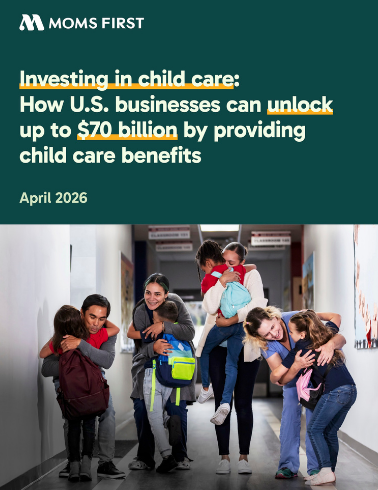
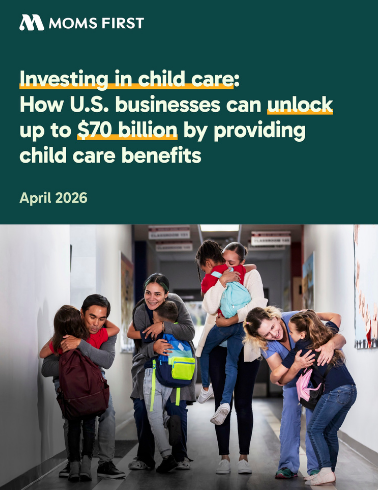
This week Moms First’s National Business Coalition for Child Care, a growing network of companies making child care a business priority, released the Foundational Workers Report with analysis provided by McKinsey & Company.
The report shows something striking: Child care disruptions create up to $70 billion in opportunity for U.S. businesses.
That’s not a typo.
It’s not a soft estimate.
It’s a measurable cost tied to lost productivity, absenteeism, and turnover — hidden costs that quietly erode profitability, whether companies recognize them or not.
And for foundational workers — the people powering industries like healthcare, manufacturing, retail, and education — the impact is even more concentrated. This segment alone accounts for an estimated $35–$45 billion of total employer losses each year.
It’s worth noting: these are the jobs AI can’t replace — even if companies wish they could.
This is what it looks like when a workforce can’t function — and it’s impacting employers’ bottom lines.
What the Data Makes Clear
We won’t unpack the entire report in this email — you can read it here. (Seriously. It’s one worth sharing.)
But here’s what matters most:
- Child care disruptions are nearly universal.
Nearly 9 in 10 parents report that child care issues impact their ability to work. - The cost is concentrated where the economy depends on it most.
Foundational workers account for $35–$45 billion of annual losses alone. - Businesses are already feeling the pain.
When child care falls through, shifts go unfilled, production slows, and employees are forced to leave jobs they would otherwise keep.This isn’t a future risk. It’s already happening inside companies, every single day.
For years, child care has been treated as a “nice-to-have” benefit, but the data tells a different story. Child care is core to whether a workforce functions at all. And increasingly, it’s becoming a competitive advantage for the companies that choose to act.
What We Saw Yesterday
Yesterday, we brought this data into the room.
At our National Business Coalition for Child Care convening, leaders from across business, policy, and the child care sector came together to confront what’s been hiding in plain sight: this is not about work-life balance. It’s about operational risk.
New York Governor Kathy Hochul joined the conversation, alongside leaders from Chobani, JBS Foods, Simple Modern, and University of Arkansas for Medical Sciences. These leaders pointed to the real-time consequences inside their own companies: persistent scheduling gaps, missed shifts, and workers forced to leave jobs they would otherwise keep.
The event also brought together leaders from across the child care sector, including our gold sponsor, KinderCare.
And what we heard, over and over again, was this: When child care falls through, everything else does too.
Shifts go unfilled.
Production slows.
Employees leave jobs they want to keep.
Not because they don’t want to work. But because the system makes it impossible.
What This Means Now
There’s a reason we’re doing this work. Because data can change who owns the problem.
For too long, child care has been framed as something families, specifically mothers, are expected to figure out on their own.
But this report makes something undeniable: What has been treated as a personal challenge is, in fact, a measurable constraint on our economy.
And more than that: It’s already costing businesses billions — and companies that invest in solving it are seeing real returns in retention, productivity, and stability.

Which leads to a different kind of question:
Not should companies invest in child care.
But can they afford not to?
Read It. Share It. Use It.
If you’ve ever:
- tried to explain to an employer why this matters.
- felt the gap between what’s expected of you and what’s actually possible.
- wanted proof that this isn’t just personal.
Then this report is for you.
Use it in conversations.
Send it to your leadership.
Share it with your networks.
Because the more we shift how this issue is understood, the faster we can change what happens next.

Bring It to Your Community
If you’ve been thinking about hosting a screening of our upcoming documentary about motherhood in America, this is your moment.
We just opened up our scheduling platform for the American Motherhood Tour, and moms across the country are already putting gatherings on the calendar. Check out the public screenings to see if another mom is hosting in your city.
Here’s the thing: there’s no perfect way to do this.
Your screening can be a private event with a few friends in your living room, a conversation within your workplace, or a bigger community event open to the public. Casual or structured. Big or small.
What matters is creating a space where people can show up honestly and realize they’re not alone.
Because that’s how this movement grows.
2 Weeks Left to Get Your Name in the Film Credits
There are just two weeks left to become an Associate Producer (AP) and have your name included in the film credits.
It takes just a few minutes to sign up but the legacy you’re leaving will last far beyond that.
You can become an Associate Producer by:
We’ve been blown away by the stories already coming in — take a look at a few on our site.
A Little Extra for Our APs
Becoming an Associate Producer also comes with a few surprises.
If you’re in the Chicago or Minneapolis area and already an AP, keep an eye on your inbox next week…you’ll receive an invite to our film premiere in your city this June.
And if you’re interested but haven’t signed up yet, now’s your moment.
What happened this week reflects something bigger. Child care is no longer a social issue waiting for political will.
It’s a business problem that’s already being paid for by companies that don’t yet realize they’re paying for it.
And once you see it that way, you can’t unsee it.
Let’s get down to business,
Reshma Saujani