
It starts with an email.
Actually, it starts with seventeen emails. The school district. The room parent. The PTA. The after-school program. The soccer coach. The pediatric dentist reminding you about the October cleaning you haven’t booked yet.
And somewhere in there, one more: a notice that your child’s school is now using an AI-powered communication platform that will “streamline updates for busy families.”
Streamline for whom, exactly?
Back to school is supposed to feel like a fresh start. New backpack, new teacher, new schedule, new routine. But if you’re the one running the household, it’s also the moment every institution your family touches resets its login, re-enrolls you in its system, and assumes that someone will read all of it and show up prepared. That someone is you.
AI is infiltrating every aspect of our lives. Your kid’s school is using it. Your work wants you to become “AI native.” Your teenager just hit her Claude token limit, and somehow that became your problem to solve too. Everywhere it shows up, someone’s calling it convenience, or efficiency, or inevitable.
I use AI too. It helps me with my research, for initial drafts, for tackling the hundred small things that used to eat up my day. I’m not writing this from outside the technology. I’m writing it from inside it, at 11pm, still on my phone.
And from where I’m standing, convenience and more work are starting to look a lot alike, especially when I look at who’s actually absorbing it. It’s not landing evenly. It’s landing on moms.
That’s what this one’s about.
Who Actually Downloads the App
There’s a term for the invisible work of running a household: the mental load. It’s not the laundry or the pickup line itself. It’s remembering that both need to happen, planning around them, and carrying that awareness all day whether or not anyone else notices it’s there.
Mothers handle 71% of it, compared to 45% for fathers. It’s why you know the permission slip is due Thursday before anyone reminds you.
Enter the AI family-organizer app. There’s a whole category of them now, and they promise what every overwhelmed parent wants: sync the calendar, parse the newsletter, track the appointment, plan the meal, find the camp.
The apps are real, and the time they save is real. An extra hour matters and I’m not going to pretend otherwise.
But somebody has to download the app, set it up, teach it your family’s rhythms, and keep it fed with information. That somebody is, almost without exception, mom.
The mental load never got redistributed. Mom just got a smarter tool to carry it alone.
The Chatbot in the Bedroom
The app on your phone is the mild version, honestly. Because AI doesn’t stop there. It follows your kid into their bedroom too, in the form of the generative AI chatbots now built into nearly everything a teenager touches, from homework help to the AI companions built specifically to keep them talking.
What we know from Common Sense Media’s 2025 national survey of over a thousand teens :
- 72% of U.S. teens have used an AI companion at least once
- 52% are regular users, engaging at least a few times a month
- 13% use one daily; another 21% use one a few times a week
Chatbot companion apps like Character.AI, are now facing wrongful-death lawsuits tied to teen suicides, and are a part of a much bigger landscape of AI endangering children.
Regulation hasn’t caught up. Legislation like the Youth AI Privacy Act is still moving through committee, which means until Washington acts, the policing job defaults to the same place it always does: Officer Mom, on top of already being the family’s social media watchdog.
The Office Equation
At work, AI is showing up for moms in two forms, and neither one is comfortable.
The first is real: the threat of displacement. 21% of companies have already stopped hiring for entry-level roles because of AI, and roughly a third expect entry-level positions eliminated at their organization by the end of this year.
That’s not a hypothetical. That’s a survey of nearly a thousand U.S. business leaders, describing decisions they’re already making.

Source: ResumeTemplates.com survey of nearly 1,000 U.S. business leaders
The second is quieter, and it’s the one I think about more: expectation inflation. If AI can do the work of an intern, the logic goes, one person can now carry the load of two. Nobody asks whether that math actually holds up. A tool that drafts something in ten minutes doesn’t make the thinking, the fact-checking, or the fixing take ten minutes too, but the deadline shrinks anyway, because “you have AI for that now” has become the go-to justification for a smaller team and a shorter runway.
AI at work is raising the bar without raising the floor.
And back to school makes it sharper, because September is exactly when pickup times shift, when the after-school gap opens up, when a working mother’s logistics get harder, not easier. That’s the week your boss wants the first draft by end of day.
After all, you have Claude now, right?
We Get to Define What Help Looks Like
Convenience is not neutral. Every AI tool requires someone to integrate it, maintain it, worry about it, and clean up when it fails, and in households where the mental load already falls on mom, AI can amplify that load even while it’s marketed as reducing it. Forget “what can AI do.” The real question is who’s doing the work of making AI work.
Moms are not anti-technology. We are some of the most resourceful users of it there are, building our own workarounds and getting it done with whatever tool is in front of us. We’re not asking anyone to take the tools away. We’re asking for a world that actually matches the tools to the conditions.
Real help looks like paid leave. Affordable childcare. Flexible work that doesn’t disappear the second it’s inconvenient for someone else. A household where the mental load is genuinely shared, not just visible on a shared calendar.
AI can be part of that future when it’s built with moms in mind and never used as an excuse to ask more of women who are already doing everything.
Remember that we get to decide what help actually looks like. Let’s not let anyone else define it for us.
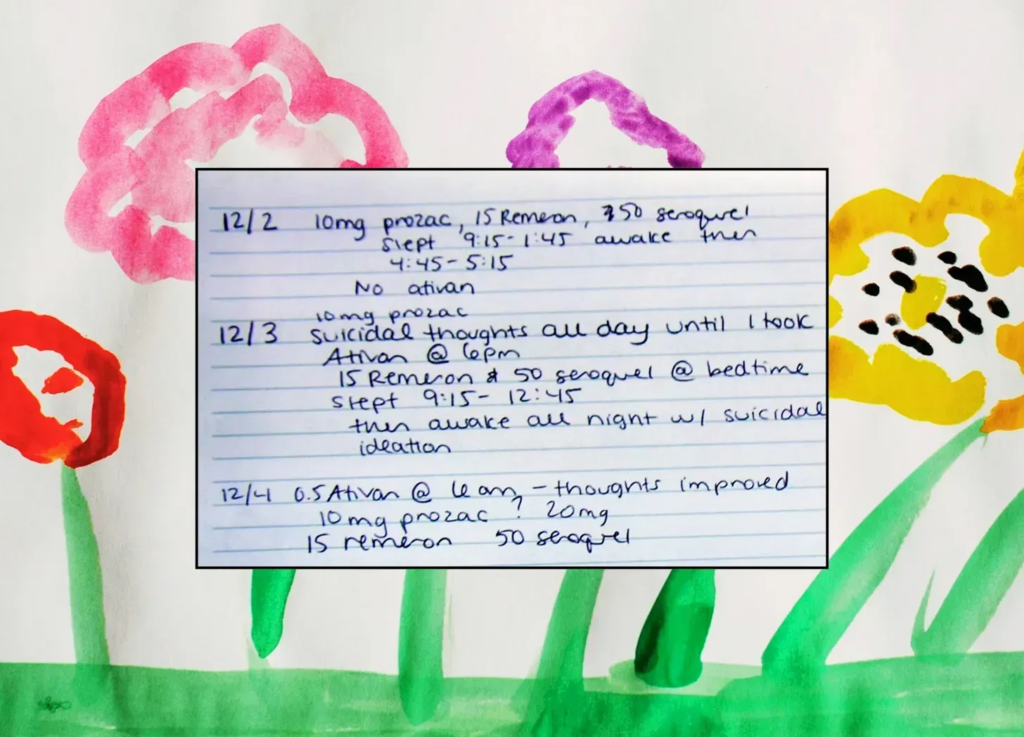
Medications, timelines, feelings, all logged by hand. A page from the notebook Lindsay Clancy kept as she tried to track what was happening to her.
Photo by Greg Derr/Pool via Reuters
Everyone Failed Lindsay Clancy
This week, I wrote about Lindsay Clancy on my Substack, Here’s The Thing, and I wanted to bring the article to you directly rather than let it get lost in your feed. Because it is a really important topic for our Moms First community. It’s about postpartum psychosis, about the system that was supposed to catch Lindsay and didn’t, and about how much closer any of us could be to her story than we’d like to admit.
It’s not an easy read. It’s an important one.
If you or someone you love is in crisis, in danger of harming themselves or their baby, or experiencing symptoms like hallucinations, delusions, or paranoia, do not wait: dial 988 to reach the Suicide & Crisis Lifeline or go to the nearest emergency room. Postpartum psychosis is a medical emergency, not a personal failure.


Thinking About Hosting a Screening? Join Our Virtual Office Hour on Aug 12
If No Country for Mothers has been on your mind but you’ve got questions before you commit to hosting a screening, we’re holding a casual office hour on Wednesday, August 12, 12:30-1pm ET to walk through it together.
Come with your questions, we’ll come with tips from the team, and you’ll leave ready to bring your own gathering to life. No prep required, just show up.
No Country for Mothers: Screenings Happening Near You
Nearly 600 screenings are already scheduled across the country. Find one near you, or if you can’t make it in person, join a virtual screening instead.
- Rochester, NY, Aug 10, 4:30-7 PM at Central Library of Rochester and Monroe County — RSVP
- Minneapolis, MN, Aug 10, 6:30-8:30 PM at Modist Brewing Co — RSVP
- Virtual Screening (Snowmass Village, CO), Aug 10, 8-9:15 PM — RSVP
- Virtual Screening (Harrison, NY), Aug 12, 12:30-1:30 PM — RSVP
- Worcester, MA, Aug 12, 5-8 PM — RSVP
- Anacortes, WA, Aug 12, 6:30-8:30 PM at Anacortes Cinema — RSVP
- Seattle, WA, Aug 13, 6:30-9 PM — RSVP
- Virtual Screening (Austin, TX), Aug 14, 2:30-4:30 PM — RSVP
- Manchester, NH, Aug 14, 6-7:30 PM at Wellness Village NH — RSVP
- Virtual Screening (Queens, NY), Aug 15, 11AM-2 PM — RSVP
- Pueblo West, CO, Aug 15, 3-5 PM — RSVP
- Kohler, WI, Aug 15, 6-9PM — RSVP
- Virtual Screening (Honolulu, HI), Aug 16, 2-4PM — RSVP
Want to host your own? Head to our Host Hub for all the info you need to set up your event.

Five Moms. One Podcast. A Lot of Honesty.
After the premiere of No Country for Mothers, five moms who became Associate Producers on the film sat down together to talk about what actually took them to their breaking point, and what it took to feel less alone on the other side. Mom guilt, comparison culture, being laid off eight months pregnant, the whiplash of being celebrated while pregnant and forgotten the moment the baby arrives. It’s honest in the way these conversations rarely get to be, and by the end, five strangers sound like old friends.
If you’ve ever told yourself I’m fine, I’ve got this while quietly falling apart, this podcast for you (and also check out the Part 2 with Genevieve Havemeyer-King, one of the moms featured in the documentary).
Many thanks to Mom Life Juntas podcast host, Jocelyn Flores, along with Claire Hoon, Seleene D’Souza, Victoria Eisen, Fatouma Jatta, and Brittani Cotton for sharing their stories.

Check out what people are saying about Moms First in the news
- Moms Are Showing Us That Child Care Is An Economic Issue (Forbes)
- Documentary On American Motherhood Highlights Local Issues With Childcare And Maternal Health (The Bay Net)
AI can draft the email. It can’t do the worrying or the showing up for each other, and honestly, that part was never going to be automated. That’s the work Moms First exists to do, and we’re doing it because you’re in this with us.
Having each other’s backs over bots,
