
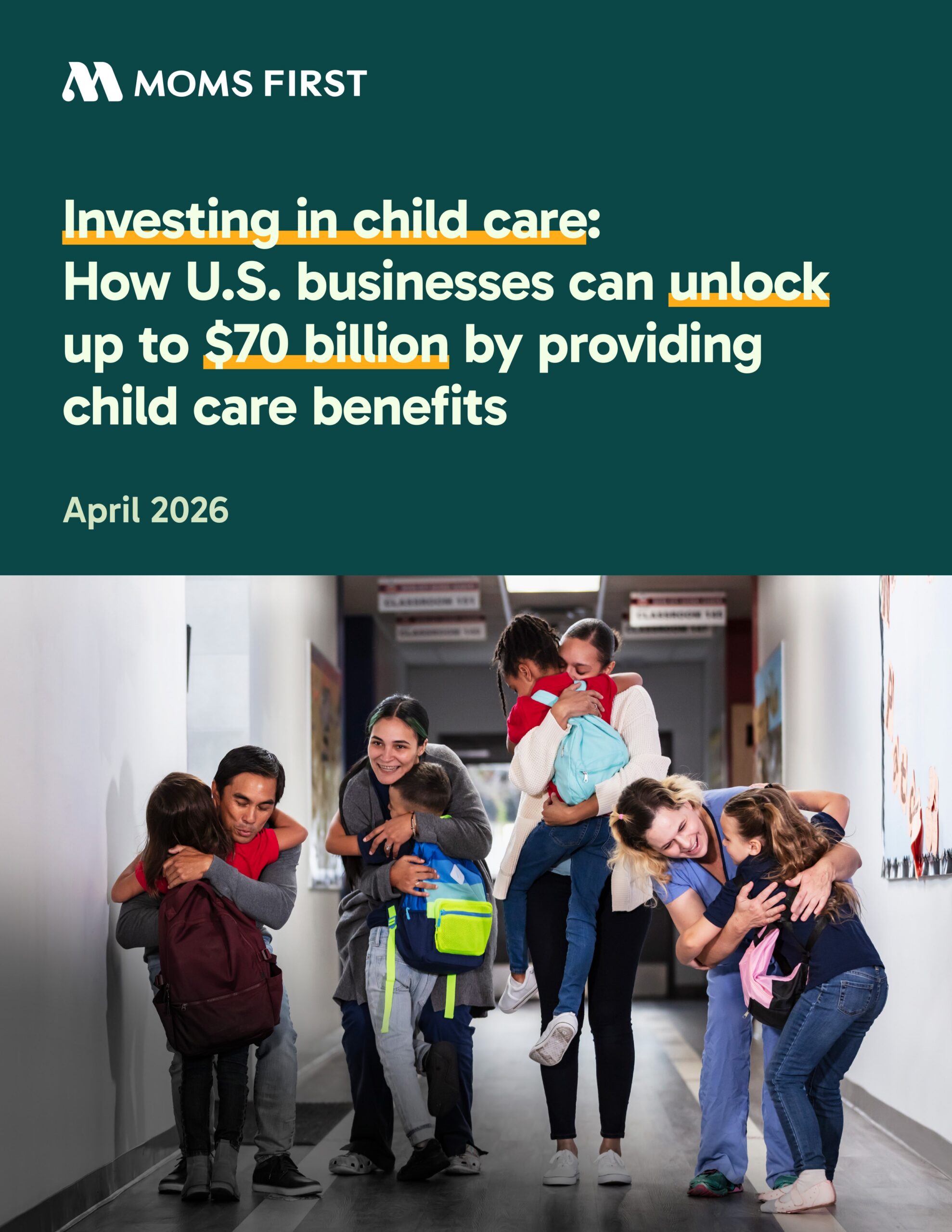
Child Care Disruptions Create Up to $70 Billion in Opportunity for U.S. Businesses, Moms First Finds
The greatest opportunity lies in foundational workers — roles AI can’t easily replace — and the businesses that depend on them.
New York, April 15, 2026 — As U.S. companies face historic instability driven by artificial intelligence, automation, and global disruption, a new analysis identifies a proven opportunity to stabilize the workforce: child care. Child care disruptions cost the U.S. up to $70 billion annually in lost productivity, turnover, and absenteeism, according to a new report released by Moms First’s National Business Coalition for Child Care, a growing network of companies making child care a business priority, with analysis provided by McKinsey & Company.
The “Foundational Workers Report” draws on a national survey of 1,700 working parents, along with census and labor market data and interviews with leading employers across the nation.
The research finds that at the center of the opportunity are foundational workers, critical human-dependent roles across industries such as healthcare, education, manufacturing, retail, and hospitality that persist even as AI is widely adopted. Notably, foundational workers account for approximately 80% of the U.S. workforce. These workers account for approximately $35-45 billion of that loss, roughly the size of Netflix’s annual revenue, making access to reliable and affordable child care a necessity for the stability of the workforce and our economy.
“As companies race to adopt AI, the foundational workers our entire society depends on aren’t going anywhere,” said Reshma Saujani, Founder and CEO of Moms First. “Without child care, they can’t work. When a nurse can’t find last-minute care, that’s a shift missed. When a teacher’s daycare closes, a classroom goes unstaffed. If companies want a chance at growing in an era of disruption, investing in child care is one of the smartest bets they can make.”
Key findings include:
- Foundational workers account for $35-$45 billion, or 60 percent, of total employer losses from child care disruptions
- Nine in ten parents say child care disruptions have caused them to miss work, reduce hours, leave a job, or exit the workforce
- Addressing the gap would have an economic impact comparable to adding roughly one million full-time workers to the U.S. labor force, or doubling the entire workforce of San Francisco
- Targeted employer-interventions can have an average ROI of 5-300% or higher
“We often think about infrastructure as roads, ports, or power grids—but child care plays a similarly critical role,” said Ramya Parthasarathy, Partner at McKinsey & Company. “It enables millions of workers to participate in the economy each day, and when access is disrupted, businesses see the impact through absenteeism, turnover, and lost productivity.”
Addressing the United States’ child care crisis requires bold public policy, however, the report indicates that companies can take immediate, practical steps to ensure foundational workers have access to affordable and reliable child care.
The companies highlighted in this report demonstrate that solutions are practical and effective. Programs such as backup care, predictable scheduling, child care stipends, and on-site or nearby centers are linked to measurable improvements in workforce stability, retention, and productivity among foundational workers.
The report argues that, for the foundational workforce, child care is no longer a “nice-to-have” but a competitive differentiator for companies who rely on foundational workers.
With rising child care costs, ongoing provider shortages and demographic trends increasing caregiving demand, the question for employers is no longer whether to act, but whether they can afford not to.
The Foundational Workers Report is available at momsfirst.us/foundational-workers-report
###
About Moms First
Moms First is fighting for America’s moms. Our mission is to win paid leave and child care as economic imperatives that allow families to thrive. Our vision is a country that values motherhood and supports moms and families.
Learn more at momsfirst.us.